- ChatGPT answers many questions from training data, but it runs web searches for "who should I hire" questions.
- When someone asks for a local business, ChatGPT looks up business listings and runs a regular web search in the same call, and 95% of the 27,405 local answers in our census carried a card of businesses.
- Across 116 local answers we captured, its search returned a median of 12 web pages, and the answer cited 2 of them.
- Directories and Yelp carry real weight in local answers. Angi was a source on 16.5% of 41,160 of them, and the star rating on the card matched Yelp's for more businesses than Google's, though Yelp never reached a majority.
- There's no rank in an AI answer. Asked the same question twice a few minutes apart, ChatGPT returned the identical set of businesses 3.6% of the time, across 188,520 pairs.
- Our reading of what to do, in order, is to make your site readable to AI crawlers, keep your listing right, earn a place on the directories and review sites these answers cite, and measure how often you're named with a margin of error.
What this guide is built on
Every number on this page comes from one of these datasets or from a primary source linked where we use it. We keep the names of the businesses in our data private.
| Dataset | What it is | Size | Collected |
|---|---|---|---|
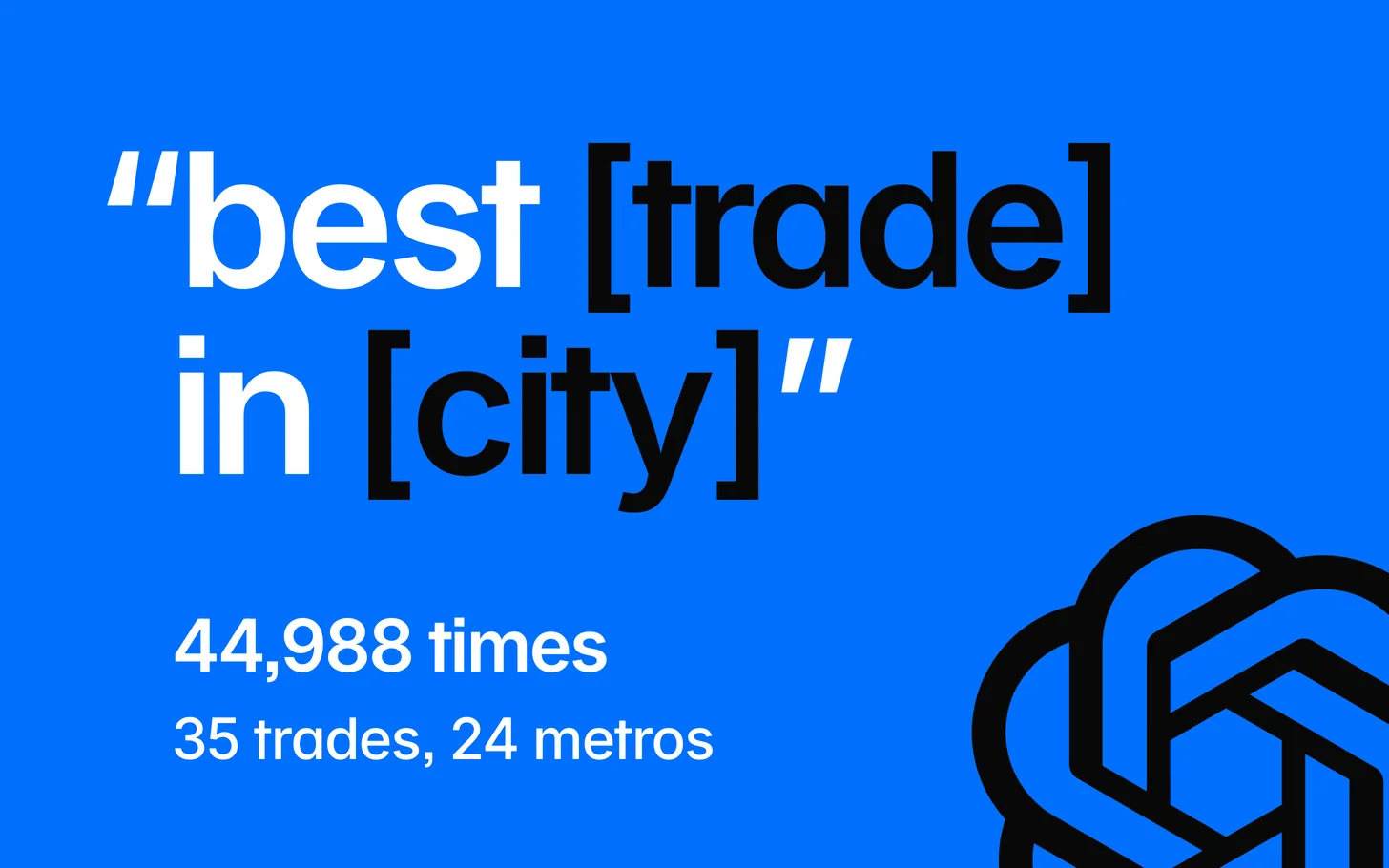
| Local answer census | ChatGPT answers to "best [trade] in [city]" and six other phrasings in 24 US metros, collected through a commercial ChatGPT scraper (DataForSEO) | 44,988 answers, 27,405 in the main analysis of 35 home-service trades | Sept. 3–7, 2026 |
| Repeat study | 46 prompts asked again and again at seven points 12 hours apart, same scraper | 12,120 answers, 188,520 same-sitting pairs | Aug. 24–27, 2026 |
| Logged-in captures | The full conversation data a logged-in ChatGPT browser receives, free account, memory off | 116 conversations, with the search call readable on 100 | Sept. 8, 10 and 23, 2026 |
| Ads check | Fresh one-question conversations on the same account | 16 conversations | Sept. 23, 2026 |
| Cross-engine run | The same 10 local prompts on ChatGPT, Claude's API, Perplexity's API, Gemini's API and Gemini's consumer app | 2,560 ChatGPT answers, 1,200 on each other surface | Aug. 24–27, 2026 |
| Access census | Independent local business websites tested against AI crawlers | 15,834 live sites, from 24,000 sampled in 40 US metros | Aug. 20, 2026 |
| Brave study | Claude's own search queries rerun on Brave and on Google | 1,481 matched queries | June–Aug. 2026 |
| llms.txt study | AI bot visits to WordPress sites running our llms.txt plugin | 6,455 opted-in sites | 30 days to June 14, 2026 |
| Assistant traffic study (verifyagents.org) | Edge logs from 174 small and mid-sized business sites on Cloudflare | 128 tagged AI clicks on 22 sites | Sept. 4–8, 2026 |
| Concept questions | 92 questions about AI search, each asked in three separate sittings on ChatGPT Plus | 276 answers, 482 search queries | Sept. 24–25, 2026 |
How to read the evidence
- Measured means a number from our own data, shown with its sample size and dates.
- Verified means a statement we checked against a primary source, such as OpenAI's or Google's own documentation, linked where it appears.
- Our reading means our interpretation of the evidence. It's labeled in the text, and it isn't a tested result.
Part 01You ask a question
Who’s the best [service] in [City]?
Part 02The engine goes looking
Business listings
Web search
Part 03It picks what to use
12 returned, 2 cited
Part 04It writes the answer
ChatGPT looks up business listings and searches the web at once, brings back 12 pages and cites 2 of them in the answer.
Part 1 You ask a question
Where an AI answer gets its information
An AI answer can draw on four sources. There's what the model learned in training, a search index the engine built earlier, a live visit to a page while you wait, and data a company has licensed. Small local businesses barely show up in training data, so for them the search routes do most of the work.
What the model already knows
A language model reads your question as tokens, which OpenAI describes as units that can be "a character, part of a word, a whole word, or punctuation," about four characters each in English. What it learned in training lives in its weights, the "large sets of numbers" that get adjusted as it learns. A 2023 study found that a model answers a factual question better when more of its training documents relate to that question, so a small local business with few mentions online is thin in a model's memory.
ChatGPT's current models also reason before they answer. OpenAI's developer docs say these models "use internal reasoning tokens before producing a response" and that OpenAI doesn't expose the raw reasoning. In the 116 ChatGPT conversations we captured on local questions, the only trace of that step was a one-line status such as "Searching 7 websites."
The model underneath changes often, too. OpenAI's model release notes list 15 dated entries between January and August 2026, from new models to updates and retirements. What a model holds about your business from training changes slowly, and nobody outside the company can measure it (our reading).
How new information gets in
OpenAI's web search docs describe its search tool fetching "live content" or using only "cached/indexed results," and Yelp licensed its reviews, ratings, photos and business information to OpenAI in July 2026, Search Engine Land reported.
ChatGPT decides for itself when to search. OpenAI says it "may search the web automatically when your question would benefit from current information." On local questions it searched every time we could see its search call, 100 times out of 100. We asked it the same 92 general questions about AI search in three separate sittings on Sept. 24 and 25, 2026, and 79 got the same treatment every time, with 58 using the web in all three sittings and 21 in none. The 21 included 8 of the 10 questions that asked for a definition, while all 8 questions about AI visibility tools and both questions asking which agency to hire searched every time.
Switching web search off doesn't turn a local answer into pure memory. When we asked ChatGPT local questions through a commercial scraper with its web search setting off, 95.5% of 3,303 answers still carried ChatGPT's card of businesses.
ChatGPT's memory is about the person asking. OpenAI describes it as preferences and details ChatGPT remembers from that person's own past chats, saved memories and connected apps such as Gmail. In our reading it shapes what one customer sees, and it isn't a record of your business that you can update.
Compare what ChatGPT knows about you before and after it searches
Open a new chat and ask, "Without searching the web, what do you know about [your business name] in [your city]?" If you use ChatGPT's memory, start a temporary chat and choose Unpersonalized before you type, or turn memory off, so what it remembers about you stays out of the answer. Then open another new chat, choose Search from the tools menu, and ask the same question.
The first answer is roughly what the model holds without searching, and the second is what it finds live. If a map or a card of businesses shows up in the first answer, that's the same card our web-search-off test kept seeing.
What is query fan-out, and what does ChatGPT actually search for?
Query fan-out is an engine turning one question into several searches of its own. Google says AI Overviews and AI Mode may do this, "issuing multiple related searches across subtopics and data sources." OpenAI says ChatGPT "typically rewrites your query into one or more targeted queries" and may send "additional, more specific queries" after it reviews the first results. In the raw conversation data we capture from a logged-in browser, search shows up as a tool the model calls with words it picked, so our reading is that the query a business has to match is one the customer never typed.
On local questions the fan-out is small. In all 100 logged-in captures where the search call was readable, from Sept. 8 and 10, 2026, a single call carried two halves side by side, a lookup in an index of business listings and a regular web search, before the model wrote anything. The lookup named a place and one to four category phrases, and the web side was one query on 92 of the 100 and two on the other 8. Each answer also made an earlier call that repeated the customer's question word for word. Our post on the six steps behind one answer follows the rest of that data.
Both halves add words the customer didn't type. Across those 100 lookups, "top rated" appeared in 12 and "licensed" in 2, and none of the 100 questions used either phrase. "Best" appeared in 38 lookups, and all 38 of those questions had typed it, so the engine carried it over and never added it. On the web side, 70 of the 111 queries contained "review," a word that appeared in none of the questions.
best plumber in Austin
Business listings
Austin, TX, USA
best plumbers
top rated plumbers
emergency plumbers
Web search
best plumbers Austin TX reviews 2026
For a search such as “best plumber in Austin,” ChatGPT sends two searches in one call, adding the words in blue.
A commercial scraper sees a thinner slice. Our census scraper kept the search queries on only 877 of its 44,988 answers, 1,347 queries in all, and in those the city appeared in 91.7%, the trade in 96.7% and "review" in 31.9%. The scraper and the logged-in browser ran different prompts through different instruments, so the two "review" figures aren't comparable head to head.
The added words change with the question. When we asked ChatGPT 92 questions about AI search itself on Sept. 24, 2026, once each on a Plus account, 59 answers made a search call and wrote 147 queries between them in that one sitting. Of those queries, 49 used a site: operator (a command that limits a search to one website), 42 of them pointing at a company the question named, and 40 added the word "official," though no question contained either. It also added "2026" to 21 queries across 19 questions, none of which named a year. When we asked the same questions in two more sittings, the topic of each search held and the wording didn't. Of the 56 to 61 questions that searched in both sittings of a pair, only 3 to 5 repeated even one query word for word, while about two-thirds of one sitting's query words turned up again in the other, and 56% to 62% of each sitting's queries still carried site: or "official."
Since Sept. 23 the lookup line has been harder to see. In our Sept. 23 captures the stored search call came back blank, and only the web queries could still be read, from a separate field. The call text was still blank in the captures we made the next day. That looks like a change on ChatGPT's side, and we don't know yet whether it stopped sending the lookup or only stopped storing it.
How the way someone asks changes who ChatGPT names
In our census of local answers, changing only the wording of the question changed how many businesses the answer named. On 3,915 answers of each phrasing, "list three" returned 3.4 businesses on average, the plain "best [trade] in [city]" returned 5.8, and a paragraph asking for a locally owned company with no chains, franchises or directory sites returned 10.6. The share of answers that named or cited a directory fell from 94.9% on the plain question to 46.1% on the locally owned one.
Longer questions change the shape of the answer. Google says the average AI Mode search is "triple the length of a traditional Search query." In our repeat study, questions that described a job in a paragraph and named a specific service carried a card 78% to 85% of the time, against 90% to 98% for short questions such as "best plumber in Austin," at each of five collection points with 400 answers per question type.
Two people asking the same question can see different businesses. OpenAI says ChatGPT may use "an approximate location based on your IP address" for local results, and may use saved memories when it rewrites a search. Customers also ask follow-up questions, and we haven't found a public measurement of how often they do.
We also haven't found a verified figure for how many people use AI to find a plumber, a dentist or a lawyer. The adoption surveys we've checked, such as G2's, measure business software buyers, so we don't carry their numbers over to local services.
Ask for your kind of business three ways
Use a new chat for each. Ask "best [your trade] in [your city]", then "list three [your trade] companies in [your city]". For the third, describe a real job in two or three sentences the way a customer would, and end with "who should I call in [your city]?"
Write down which businesses each answer names and whether yours is one of them. We treat each wording as its own way into the answer (our reading), and one ask of each tells you about one sitting only.
Part 2 The engine goes looking
How ChatGPT, Gemini, Claude and Perplexity find businesses
When we ran the same 10 local prompts through each engine in August 2026, only ChatGPT returned a structured card of businesses, and the others answered in prose with citations, across 2,560 ChatGPT answers and 1,200 on each other surface. We read Gemini's consumer app through a scraper, so a card that showed on screen and got dropped can't be ruled out there, and we tested Claude and Perplexity through their APIs, the versions developers use, which can differ from the apps.
They also search different places. OpenAI says ChatGPT search "sometimes partners with other search providers" and links Microsoft's and Shopify's privacy policies for them, and we haven't measured which index ChatGPT's local searches hit. All 38,307 of Gemini's API citations came back as Google grounding links, so its retrieval runs through Google. Perplexity describes a search stack of its own, which splits pages into passages and re-ranks them.
Claude's search runs on Brave, as our ten-week Brave study found. Across 1,481 matched queries from June to August 2026, 87.8% of the pages Claude's search tool retrieved sat in Brave's top 10 for the same query, against 45.6% in Google's. Brave's ranking also tracked whether Claude cited a business, and across 1,408 observations on 52 client accounts, businesses ranking 1 to 3 in Brave were cited in 92.0% of Claude's answers, 4 to 10 in 69.8%, 11 to 20 in 38.4%, and outside the top 20 in 11.9%.
The local sources overlap more than the engines do. Angi, BBB, HomeAdvisor and Expertise.com were cited on all five engine surfaces in that August run. Yelp is where they part ways, with Claude citing yelp.com in 33.2% of answers and Perplexity in 29.3%, while ChatGPT cited it on none of 2,560 answers. Yelp still shows up in ChatGPT's answers another way, since its visible card carried Yelp's rating logo on 27.9% of the 215 rows we captured in a logged-in browser, which fits the licensing deal described in Part 1 (our reading).
Apple runs its own crawler. Apple says data from Applebot powers search in Spotlight, Siri and Safari and "may be used to provide additional context and up-to-date content" when its AI models generate answers, while Applebot-Extended is a robots.txt setting for training that "does not crawl webpages." We haven't measured Siri, Apple Intelligence or Copilot answers.
We treat each engine as its own channel (our reading). The directories cited on all of them are where the effort overlaps, and a single blended score across engines hides which one you're missing from.
| Engine, and how we tested it | Where its search comes from | Card of businesses | Directory and review sites cited, share of answers |
|---|---|---|---|
| ChatGPT, through a scraper (2,560 answers) | Outside partners, per OpenAI, and we haven't measured which for local | Yes | angi.com 24.9%, bbb.org 20.1%, homeadvisor.com 15.9%, yelp.com 0 of 2,560 |
| Claude, through its API (1,200) | Brave (87.8% of retrieved pages in Brave's top 10, 1,481 queries) | No | yelp.com 33.2%, angi.com 32.2%, bbb.org 8.9% |
| Perplexity, through its API (1,200) | Its own search stack | No | angi.com 56.8%, bbb.org 52.0%, yelp.com 29.3% |
| Gemini, through its API (1,200) | Google (all 38,307 citations were Google grounding links) | No | bbb.org 25.7%, angi.com 25.0%, homeadvisor.com 24.6% |
| Gemini consumer app, through a scraper (1,200) | None captured | bbb.org 15.1%, homeadvisor.com 13.5%, angi.com 8.3% | |
| Apple (Siri, Spotlight, Safari) | Applebot | Not measured | Not measured |
Shares count answers that cited each site in the August 2026 cross-engine run, with the same 10 prompts on every surface. For ChatGPT that's the scraper's list of cited sources, which doesn't include the Yelp ratings on ChatGPT's card.
Do Google's AI Overviews show up on local searches?
Not often on a plain local search, where a 2026 study of medical practices in five US metros found an AI Overview on under 2% of "find a provider" searches, with Google keeping its map results in front. Adding a condition, an urgent need or an insurance question pushed the rate to between 22.5% and 42.2%. Across 22.4 million local searches, Ahrefs put it at 7.9%. Google itself says Overviews show only where its systems judge them "additive to classic Search," and "as such, often don't trigger."
Google describes AI Overviews as a quick way to get the gist of a question with links to explore, and AI Mode as the place for questions that need "further exploration, reasoning, or complex comparisons." It says both are built on its core ranking systems and pull pages from its search index, that both may fan a question out into several searches, and that a page has to be indexed and eligible for a normal search snippet to be linked. We haven't measured AI Mode on local service questions yet.
When an Overview does appear, fewer people click through. In Pew's March 2025 tracking of 900 US adults, people clicked a regular result on 8% of Google visits that showed an AI summary, against 15% without one, and clicked a link inside the summary 1% of the time. Those figures cover all Google searches, and plain local searches rarely get an Overview. Search Console now shows every site how often its pages appeared in AI Overviews and AI Mode, in a report Google had rolled out to all websites by Aug. 31, 2026.
Where does ChatGPT get its information about local businesses?
A local answer in ChatGPT carries two kinds of material, a card of business listings and web pages, and ChatGPT looks for both at the same moment. In all 100 logged-in captures where the search call was readable, the lookup in an index of business listings went out in the same call as the web search. The lookup is the only request shaped like a places search, and the card appeared on 97 of those 100 answers, but the data doesn't connect the two, so "the lookup fills the card" is an inference we haven't tested.
The lookup names a place. On 98 of the 100 it was a place such as "Austin, TX, USA" for a question about Austin, and on the other 2 it was the literal word "user," which we can't interpret yet. For "near me" questions, OpenAI says ChatGPT may use an approximate location from your IP address, and that it "may share your location with trusted third-party providers that help provide more local information, such as nearby business listings." Our reading is that a "near me" search starts from the customer's location.
Each business comes back as a record of 57 fields, and all 173 records across 16 captures on Sept. 23, 2026 carried the same 57. The card draws 8 of them onto the screen, covering the name, star rating, rating logo, category, photo, map position and whether the business is open. Clicking a business opens a panel with more of them, such as its address, phone and hours, and the record also holds details such as whether the listing is claimed and review highlights.
Placeholder Plumbing Co.
4.8
Plumber
Open
Its record57 fields
- id
- entity_key
- entity_lookup_id
- provider
- provider_url
- provider_logo_url
- provider_logo_dark_url
- provider_logo_url_short, drawn on the card
- provider_logo_dark_url_short
- name, drawn on the card
- latitude, drawn on the card
- longitude, drawn on the card
- distance_meters
- ranking_score
- rating_scale
- address
- description
- description_cite
- image_url, drawn on the card
- image_urls
- provider_images
- reconciled_thumbnails
- selected_images
- rating, drawn on the card
- review_count
- reviews
- review_highlights
- price
- price_str
- categories, drawn on the card
- website_url
- hours
- is_open, drawn on the card
- next_open_hour
- phone
- is_closed_permanently
- is_closed_temporarily
- rank
- country_code
- country_name
- city
- state
- zipcode
- location
- tags
- attributes
- is_claimed
- date_opened
- date_closed
- special_hours
- menu
- yelp_menu_url
- popularity_score
- reservation_providers
- service_providers
- enriched_description
- from_cache
ChatGPT gets 57 fields for each business. The card shows 8 of them.
The rows are shaped like listings, with a name, an address, a phone number and a category. Their business identity tracks Google's listing data, and nothing in the data says which provider supplies that layer. A logo field on each row records where its star rating came from, and Part 3 covers how often that's Yelp.
Across 276,628 card rows in our census of 44,988 local answers, 62% of businesses had an address in the metro's principal city and 95% inside the metro, 56% listed the trade that was asked about as their category, and 64% carried a website. That leaves 36% of card rows with no website attached. Our reading is that the listing gets a business onto the card, and that an address in the named city and the asked trade as the primary category are the entry conditions to check first, though we haven't tested either one.
The card isn't the whole answer. Of the answers that carried a card, 70.4% also named at least one business the card didn't hold, and Part 3 looks at the web pages cited beside those names.
Can AI crawlers read my site?
About one local business site in four can't be read by AI crawlers.
AI companies send three kinds of visitor. A training crawler collects pages that may be used to train future models (OpenAI's GPTBot, Anthropic's ClaudeBot), a search crawler builds the index an assistant searches (OAI-SearchBot, Claude-SearchBot), and a user-triggered fetcher opens a page while a person waits for an answer (ChatGPT-User, Claude-User, Perplexity-User). We keep a fuller list of AI crawlers with what each one does.
OpenAI treats its crawlers separately. It says a site that blocks OAI-SearchBot "will not be shown in ChatGPT search answers," though it "can still appear as navigational links." Blocking GPTBot tells OpenAI not to use the content for training. Because a person starts a user-triggered fetch, OpenAI says robots.txt rules "may not apply" to it, and Perplexity says its fetcher "generally ignores" them. Google's AI features crawl as ordinary Googlebot, so there's no separate Google AI crawler to allow or block for AI Overviews.
In our access census of 15,834 live independent local business websites in 40 US metros, collected Aug. 20, 2026, 23.77% were unreadable to at least one of the 11 AI crawlers we tested for, or 27.06% when weighted to the makeup of the full sample. The causes were a robots.txt rule, a block or error at the host or CDN (the network layer many sites sit behind), or a homepage whose raw HTML didn't say what the business does along with a contact detail or location. About 9% of the sites that loaded for a normal browser turned away a request carrying an AI crawler's name (8.0% to 11.0% of 13,760, depending on how we count rate-limit responses).
OpenAI says "any public website can appear in ChatGPT search." Its advice is to allow OAI-SearchBot in robots.txt and to confirm that your host or CDN lets OpenAI's published IP addresses through, and it says a robots.txt change takes about 24 hours to reach ChatGPT search. Your server logs show some of these visits, but a quiet log doesn't mean you weren't used, because plenty of answers come from copies an engine stored earlier.
Check whether AI crawlers can read your site
Open yourdomain.com/robots.txt and look for a group naming GPTBot, OAI-SearchBot, ChatGPT-User, ClaudeBot, Claude-SearchBot, Claude-User, PerplexityBot or Perplexity-User with "Disallow: /" under it. Check the "User-agent: *" group too. Under the robots.txt standard, a crawler with no group of its own follows that one, so a "Disallow: /" there blocks it.
Then ask whoever runs your hosting or CDN whether a bot-blocking or AI-blocking setting is on, and whether it lets OpenAI's published IP addresses through. A robots.txt file can look open while the layer in front of the site turns AI crawlers away.
Do I need an llms.txt file?
For a local business it's optional (our reading). An llms.txt file is a plain text file at yoursite.com/llms.txt, meant to give AI crawlers a digest of a site's most important content. Google says Google Search doesn't use llms.txt files and that making one "will neither harm nor help your site's visibility or rankings in Google Search." It says the same about Markdown copies of pages and other files made only for AI.
We measured which AI bots fetch the file. Across 6,455 WordPress sites running our llms.txt plugin that opted in to share bot data, 626 (9.7%) had a recognized AI bot fetch /llms.txt in the study's final 30 days, which ended June 14, 2026. OpenAI's crawlers led, with OAI-SearchBot fetching it on 8.5% of the 5,567 sites it crawled and GPTBot on 8.4% of 4,434. The fetchers that act while a person waits almost never did, with ChatGPT-User at 0.4% of 5,634 sites and Perplexity-User at none of 2,895, and most bots that fetched the file did so once and didn't return.
That study counted fetches. It didn't test whether having the file changes whether a business gets named or cited. It also logged no fetches from Google-Extended, which is expected, because Google says Google-Extended "doesn't have a separate HTTP request user agent string" and works as a robots.txt control over whether Gemini can use your content for training and grounding. In our reading, an llms.txt file won't hurt and is unlikely to move a local answer, where the card carries listing data and the prose cites directories and business sites, so a readable homepage and an accurate listing come first.
Does ChatGPT read my page at all?
About one time in four, it doesn't read it at all while the customer waits. Across 22 small and mid-sized business sites, 26% of 128 clicks from AI answers that carried a tracking tag had no AI assistant fetch of that site in the seven days before, the verifyagents.org study found. Its likeliest explanation is that the assistant answered from an index built earlier, and the study says it measured the missing fetch and not the reason. Google calls tying an answer to retrieved pages "grounding," and OpenAI's docs say its search tool can use "cached/indexed results" as well as live content.
When an engine does read a page, it may use only part of it. Perplexity says it splits pages into self-contained passages and ranks each one, and Google says it can find the relevant part of a long page, so you don't need to chop content up. OpenAI hasn't said how ChatGPT handles it.
So each page should answer its main question near the top, in body text a crawler can read (our reading). Don't rely on an assistant's account of its own visit either, since two of the eight assistants in the same study described theirs wrongly.
Part 3 It picks what to use
Why ChatGPT reads a page and doesn't cite it
An answer cites only a few of the pages its search brings back, so most pages ChatGPT pulls in never get a citation. Across 116 local questions we captured in a logged-in browser on Sept. 8, 10 and 23, 2026, its search returned a median of 12 web pages for each answer, and the answer cited 2, the split we found when we took one local answer apart. The share cited held on all three dates, at 20.7% of returned pages on 60 captures, 19.4% on 40 and 21.9% on 16.
We read the 12 as the size of one search's result list more than a choice the answer made, since all 16 captures from Sept. 23 returned 12 pages apiece. Every page an answer cited was one its search had returned, 302 of 302. OpenAI says ChatGPT ranks search results on several factors and that placement isn't guaranteed, and it hasn't published how an answer picks which results to cite.
The one-in-five share holds up under other ways of counting. Counting only the pages the search tool itself returned, 23.1% were cited, and counting the extra sites listed under each citation as cited too, 25.9% were, so the fair range is one in five to one in four.
You can see some of the uncited pages yourself. OpenAI says the Sources button under an answer shows "cited sources and other relevant links," and in our captures the data behind that list held pages the search returned that the answer didn't cite. Business websites turn a search result into a citation more often than directories do. On 595 answers from our census scraper where both lists were visible, directories were 39.8% of the pages returned and 29.9% of the pages cited.

Being cited and being named are separate outcomes. In our census, on answers that carried a card, 72.5% of the businesses named in the text were on that answer's own card, and card rows carry listing data and aren't cited web pages, so a business can be named with no page of its own cited. If ChatGPT names you but cites a directory or someone else's page when it does, we treat that as a gap you can close. Open Sources on that answer, read the page it did cite, and check whether your own page states the same facts as plainly (our reading).
What makes a page easy for AI to quote
In our reading, a page is easiest to quote when it states the facts a customer asks about in plain body text, though nobody has tested which page changes get a local business quoted in live AI answers, us included. The closest test is a lab study from 2024, which found that adding quotes, statistics and cited sources to a page raised how much of an AI answer drew on it by roughly 30% to 40%. It used a 2023 model, five pages already chosen for each question and no local questions, so it speaks to a page that's already been picked and says nothing about getting picked.
A business's own pages do get quoted. On our census answers that carried a card, business websites made up 56.5% of the cited links and directories 29.9%, across 166,017 cited links on 39,296 answers. Google says you don't need to write in a special way for its AI features, because its systems understand "synonyms and general meanings," so there's no need to chase every phrasing of a question. It also says there's no ideal page length, and to make pages "for your audience, not just for generative AI search."
We'd start with the pages that answer what a customer asks right before calling (our reading). Say whether you're licensed and insured, what drives the price, what the job involves and how long it takes, and publish the price ranges you're willing to stand behind. Whether published prices change AI answers hasn't been tested, by us or in any study we've found.
How much AI favors newer content
AI assistants lean slightly toward newer pages, citing pages that are newer on average than Google's regular results, but the average cited page is still almost three years old. Ahrefs found a 25.7% gap across about 17 million citations, with ChatGPT leaning newest, and a later Ahrefs study found that within a single answer ChatGPT tended to cite the more established pages.
ChatGPT also puts dates into its own searches. Our census scraper recorded a year added to 5.2% of 1,347 search queries, and in our logged-in captures 28 of 111 web searches ended in an extra number, 30 on 26 of them, 3650 on one and 7 on one. That looks like a time window in days, but nothing in the data labels it. We'd keep key pages current and date real updates, and we wouldn't change the date on a page that hasn't changed (our reading).
Does schema markup help me show up in ChatGPT?
We haven't seen evidence that schema markup, the code that labels facts like your hours and address for search engines, helps a business show up in ChatGPT. Google says "there's no special schema.org markup you need to add" for its AI features.
Ahrefs tracked 1,885 pages that added JSON-LD schema between August 2025 and March 2026 against 4,000 matched pages, and found no real change in their ChatGPT or AI Mode citations over the next 30 days. Their AI Overview citations fell 4.6% against the matched pages, a drop Ahrefs called small but statistically significant. Those pages were already being cited, and the study had no local split.
Structured data still earns rich results in Google's regular search, and LocalBusiness markup lets you tell Google your hours, departments and other details. FAQ markup no longer does that for a local business. Since August 2023 Google has shown FAQ rich results only for "well-known, authoritative government and health websites." Google says there's no need to remove FAQPage markup you already have, since structured data it doesn't use "does not cause problems for Search."
For ChatGPT's card, we treat an accurate listing as the lever, since the card's rows carry listing data, and accurate LocalBusiness markup on your site as housekeeping, with its hours, phone and address matching your listing (our reading). We haven't found a public test of whether ChatGPT reads JSON-LD when it fetches a page. OpenAI's FAQ for publishers covers crawler access and link tracking and doesn't mention structured data.
If you add the markup, pick the type that names your trade. Google's LocalBusiness guide says, "Use the most specific LocalBusiness sub-type possible," and to list several types when a business offers several services. Schema.org's home and construction types include Plumber, Electrician, HVACBusiness, RoofingContractor, GeneralContractor, HousePainter, Locksmith and MovingCompany, and Dentist sits directly under LocalBusiness. Google requires only the business name and address, and recommends the phone number, opening hours, a URL for the location, map coordinates and a price range. Make the name, address, phone and hours match your listing exactly (our reading). Google recommends rating and review markup only for sites that collect reviews of other businesses, so it isn't the place for your own reviews.
Where links and mentions still matter
Links and mentions still matter wherever an AI engine works from search results, which includes local questions, though no one has measured their effect on local AI answers directly. Google says SEO best practices carry over to its AI features, and in our Brave study a business's Brave ranking tracked whether Claude cited it (Part 2). Ahrefs' study of 1.4 million ChatGPT prompts reached the same point from the other side, concluding that a page has to be among the search results ChatGPT pulls, which means it has to rank, before it can be cited.
For Google's AI Overviews, mentions showed a stronger link than backlinks in the one large study we found. Across 75,000 larger brands, Ahrefs found that mentions of a brand around the web tracked AI Overview visibility more closely than backlinks did, a correlation of 0.664 against 0.218. It's a correlation, the study left out smaller sites, and Google warns that "seeking inauthentic "mentions" across the web isn't as helpful as it might seem." Google also says its AI features can show what's said about a business in blogs, videos and forum discussions.
Say what you do, where you do it and what you want to be known for the same way on your site, your listing and the directories that list you. Language models learn a fact better when more documents mention it, but no AI company says it counts agreement between websites, so we treat consistency as good hygiene with no known ranking rule behind it. We haven't seen local data on press releases. In our reading, the mentions worth earning first are on the directories and local best-of lists already cited beside your competitors, which the directory section below covers.
Reddit and YouTube
On short "best plumber in [city]" questions Reddit barely appears in ChatGPT's answers, and we have no data on YouTube. In our logged-in captures, ChatGPT's search returned a Reddit page on 2 of 96 short questions, and none of those answers cited it. On 20 longer questions written in the first person, such as a homeowner describing an air conditioner that won't stop running, it returned Reddit on 5 and cited it on 2, a sample small enough to read as direction only. That fits a September 2026 study of ChatGPT's retrieval across a range of question types, which found it pulls Reddit mainly when a question asks what people think, and cites a Reddit page at about the same rate as any other page once it reads one.
Our larger datasets haven't lined up yet. Reddit was a source on 11.3% of the 41,160 answers in our census of local answers, which mixed seven phrasings, some of them long, and ran through a scraper, and on 2.1% of 2,560 ChatGPT answers in our August cross-engine run. Until we reconcile the three readings, we don't put one Reddit number on local answers.
You may have heard that Reddit takes about a third of ChatGPT's retrieval slots. That figure traces to a 2025 study that counted 16 of 60 slots (27%) from captured traffic and measured Reddit's share of citations in a separate dataset, so the two numbers don't describe the same answers. Google and OpenAI both license Reddit's data, and Google's announcement says it can train its models on it.
We haven't measured YouTube in local answers. Google lists videos among the places its AI features can show what's said about a business, and in our reading a thread or a video helps most where customers describe a problem at length, since short "who should I hire" answers carry the card and cite directories far more often than Reddit.
Does being on Angi, HomeAdvisor or Yelp help me show up in ChatGPT?
Those directories are among the sites cited most often on local ChatGPT answers, but we haven't measured whether a listing on any one of them raises your odds of being named. Across the 41,160 answers in the main arm of our September census, collected Sept. 3 to 7, 2026, Angi was a source on 16.5%, Expertise.com on 12.8%, BBB on 12.3%, Reddit on 11.3%, HomeAdvisor on 8.7%, Birdeye on 7.7% and Houzz on 5.4%. Yelp's own website was almost never a source on those answers, while Yelp's ratings show up on the card itself, as the star ratings section explains.
Directories differ a lot in how often ChatGPT cites a page its search returned. The table shows how often each directory's pages came back in the search on our Sept. 8 captures, and how often the answer then cited them.
| Directory | Search returned it (answers of 60) | Answer cited it |
|---|---|---|
| angi.com | 40 | 14 |
| homeadvisor.com | 38 | 12 |
| thumbtack.com | 27 | 1 |
| birdeye.com | 25 | 5 |
| expertise.com | 25 | 15 |
| bbb.org | 24 | 13 |
| houzz.com | 20 | 5 |
Across all 116 captures, Thumbtack came back in 45 answers and was cited in 2, while Expertise.com came back in 45 and was cited in 24. The data shows which directories convert and doesn't explain why. Expertise.com publishes local "best of" lists, so list-style pages still get cited on local questions, even though one public study found ChatGPT citing far fewer listicles on business-software questions.
The same directories appear beyond ChatGPT. Angi, BBB, HomeAdvisor and Expertise.com were among the most cited sources on all five engine surfaces we tested in August 2026 (Part 2). How the customer asks matters too, since directory citation fell from 94.9% of answers to 46.1% when the question asked for a locally owned company and ruled out directory sites (Part 1).
In our reading, the directories and pages cited on answers for your trade and your city make up your list of where to be listed, and what those pages say about you is your list of what to fix. Working through that list is part of the work we do for clients.
Build your own list of where to be listed
In a temporary chat set to Unpersonalized, ask "best [your trade] in [your city]". Select Sources under the answer and write down every directory and review site listed there, cited or not. Ask the question the two other ways from Part 1 and add any new sites.
Then check your listing on each site for your name, phone, hours and services, and note the sites where you aren't listed at all.
Where ChatGPT's star ratings come from
The star rating beside a business on ChatGPT's card matches Yelp's more often than Google's, though Yelp never reaches a majority. We compared card businesses listed on both platforms, counting a match when the card's rating was within 0.05 stars of a platform's and the review count agreed under one of three rules, an identical count, a count within 10%, or whichever platform's count was closer. Across a panel of 479 businesses and a hand-checked panel of 72, the card matched Yelp for 48% to 54% and Google for 26% to 41%, depending on the rule. Most of the rest matched neither, and in our reading that's mostly because review counts moved between our card collection and our comparison pull.
The card records which platform it used. Each row carries a small logo field that records whose rating it shows, and 15 of the 16 rows with Yelp's logo matched Yelp's rating and review count exactly, against none of the 6 rows without it. Yelp's logo is rarer on what a customer sees first, on 27.9% of the 215 rows visible before Expand and 52.1% of the 390 behind it.
A business's review count shifts the split. On the 479-business panel, under the exact-count rule, businesses with five or fewer reviews showed Yelp's rating 71% of the time and Google's 15%, and above 100 reviews it was 22% Yelp and 30% Google. The pattern fits OpenAI's licensing deal with Yelp (Part 1), and every Yelp quote-request link in our Sept. 8 and Sept. 23 captures carried a partner tag, utm_medium=feed_v2.

Across 276,628 card rows in our census, the median business had 4.9 stars on 28 reviews. In our reading, a Yelp profile with a solid rating is on display in ChatGPT whether or not you work it, and Google's number takes over as your review count grows. We haven't tested whether the words in your reviews show up in answers, or whether a higher rating or more reviews raises a business's odds of being named.
Other engines show their rating sources in the open. In our August cross-engine run, Perplexity cited Yelp in 97.7% of the 265 answers where it quoted a rating or a review count, while ChatGPT cited yelp.com in none of the 833 answers where it quoted one. That ChatGPT figure counts cited web pages only and leaves out the ratings on its card.
Find out whose rating ChatGPT shows for you
In a temporary chat set to Unpersonalized, ask "best [your trade] in [your city]" and find your business on the card, pressing Expand if it isn't among the first few. Look at the small logo beside your rating, then compare the stars and review count with your Yelp profile and your Google listing. The census median is 4.9 stars on 28 reviews.
Make sure your Yelp profile exists and shows a rating. If your profession limits asking clients for reviews, follow its rules when you ask.
Part 4 It writes the answer
How do I get my business onto the map in ChatGPT?
Keep your listing accurate, with an address in the city customers name and your trade as the primary category, since that's our best reading of how businesses get onto ChatGPT's card, though nobody outside OpenAI, us included, knows what puts a business there. The card appears on almost every local answer, on 95.4% of 27,405 answers in our census and on 92.5% to 98.2% depending on the trade. It doesn't depend on web search either, since 95.5% of 3,303 answers still carried one when we asked with the scraper's web search setting off (Part 1).
What looks like one card holds three groups. A few businesses show before the Expand control, the full list including what's behind Expand runs to about ten, and some businesses appear only in the answer's text. Across 57 captures with a card on Sept. 8, 2026, the three lists behind one card held 215 rows on the visible card, just under four per card, 390 behind Expand and 46 businesses named only in the text.
We read the payload's first list as the visible card because the two matched on the one question where we checked the rendered page by hand, which showed five businesses before Expand. The DataForSEO scraper behind our census, which much of the industry measures with, returns the visible card and the pool behind Expand as one list, so a tool built on it reports the pool and not the five a customer sees first.
The card's business details track Google's listing data, though nothing in the data names the provider, so your Google listing is worth keeping right. Gemini works differently. In our August run neither Gemini's app nor its API returned a card or any other places layer, even though its retrieval runs through Google.
Each row also carries fields you never see, among them whether the listing is claimed and a field called ranking_score. The ranking_score field sits on every business record we've captured, the card's display order doesn't follow it, and a popularity_score field beside it has been empty on every record. Neither field is documented, and until we've modeled them we can't say what moves a business onto the card.
The routes we've found in OpenAI's documentation for sending a local business's details to ChatGPT as a feed are partner programs, one for quote requests and one for restaurant reservations. OpenAI's Get Quote spec says these plugins are "currently in beta and being tested with approved partners," who apply through the ChatGPT merchants form and send a feed of the businesses they list, and it says "ChatGPT indexes these records for search." The feed's quote field, service_providers, is one of the 57 fields on every card record in our 16 captures from Sept. 23, 2026. There, 73 businesses carried a filled one, and every one named Yelp as the provider, with the same quote widget the spec describes. Our reading, untested, is that for most owners this route runs through a platform that already has a plugin, which in everything we've captured is Yelp.
The card isn't the only way in, either. On answers that carried a card, 72.5% of the businesses named in the text were on that answer's own card, so about a quarter were named without being on it.
See where you stand on the card
In a temporary chat set to Unpersonalized, ask "best [your trade] in [your city]". Count the businesses on the card before you press Expand and note whether yours is among them, then press Expand and look for yours in the rest. The text under the card can name businesses the card doesn't show, so read that too.
Ask again in another new chat. The list will likely change, and Part 5 explains why.
How does ChatGPT decide which businesses to recommend?
It names businesses from a local pool that shifts from one ask to the next, and OpenAI hasn't published how it chooses among them. Nearly every local answer names someone, 99.7% of the 27,405 answers in our census, and the average answer named 6.6 businesses.
The pool behind one question is wide. Across 40 local questions, each asked 240 times over three days in August 2026, the average question produced about 28 businesses that each appeared in at least 5% of its answers. The median business in those pools appeared in 30% of answers, and only 36 of 1,115 business-and-question pairs appeared in 95% or more. For a typical business in a pool, being in ChatGPT means being named about three times in ten (our reading).

The pools are local. ChatGPT named 88,186 different businesses across the 44,988 answers in our census of who gets named, and 85% of a coded sample of 238 operated under their name in one metro only (95% CI 81% to 90%). Only 11.7% of card businesses appeared on the cards of more than one of our 24 metros. We read that as good news for small independents, who compete mostly with other local businesses. When a customer asks for a locally owned company and rules out chains, all 600 answers in a random sample named at least one business we could verify exists and that met the request. The wording also sets how many names an answer carries, from 3.4 on average for "list three" to 10.6 for the locally owned request (Part 1).
Google publishes the factors behind its own local results, and we haven't tested whether they carry into ChatGPT. Google's help page on local ranking says, "Local results are mainly based on relevance, distance, and popularity," and under its heading for the third factor, prominence, it counts "how many websites link to your business and how many reviews you have." The card records we capture carry a field named distance_meters, which has been empty on every record in our Sept. 8 and Sept. 23 captures, beside the ranking_score field that the card's order doesn't follow. So nothing in the data shows ChatGPT weighing distance or reviews the way Google describes, and nothing in it rules that out. The census rows in Part 2, where most card businesses had an address in the principal city and listed the asked trade, fit relevance and distance, though they show who got on the card and say nothing about why (our reading).
Answers also reach past the card, since 70.4% of the answers that carried a card named at least one business the card didn't hold. When ChatGPT names your competitors and not you, several causes are possible, and each one can be checked (our reading). You may be missing from the card, the pages it cites may not mention you, AI crawlers may not be able to read your site, or the answer may have varied from one ask to the next. Part 6 puts them in order.
Does ChatGPT show ads for local businesses?
Yes, on its Free and Go plans, and on Sept. 23, 2026, 10 of 16 fresh local questions on our free account carried one. OpenAI says ads began testing in the US on Feb. 9, 2026, appear below the end of a response labeled as sponsored, and don't show on Plus, Pro, Business, Enterprise or Edu accounts or in Temporary Chats.
OpenAI also says ads "do not influence ChatGPT's answers." Ads aren't eligible near sensitive or regulated topics such as personal health and mental health, it says, and health advertisers have to meet stricter eligibility rules. A business can sign up at ads.openai.com, where access varies by country, and OpenAI's advertiser guide suggests starting cost-per-click bids at $3 to $5. If you advertise, let OAI-AdsBot through, because OpenAI says that crawler visits an ad's landing page to check it against its policies and to judge when to show the ad.
Lead marketplaces bought most of the ads we saw. Of the 10 ads we caught on Sept. 23, 3 came from Thumbtack and 3 from Angi, the other 4 came from local businesses and brands, and 1 of the 10 advertisers also appeared on the card in the same answer. Thumbtack's pages came back in ChatGPT's search in 45 of our 116 captured answers and were cited in 2.
Tracking tools can miss these ads entirely. A few hours later, the same 16 questions sent through a commercial scraper returned no ads, 0 of 16, and the same account had shown none on the 63 answers we captured on Sept. 8. These counts come from one free account on one evening, so they don't tell you how often ads appear on local questions in general or on other plans.
How to fix wrong information ChatGPT gives about your business
Correct your listing on Google and your profile on Yelp first, since the card's business details track Google's listing data and its star ratings are Yelp's more often than Google's, then fix anything wrong on your own site. We didn't find a way in OpenAI's help center for a business to correct its details directly. You can still flag a wrong answer. The thumbs-down under an answer opens a list of issues to pick from, and OpenAI's reporting page says reported domains and other content may be reviewed by its Model Quality team, which may apply filters "to help prevent ChatGPT from relying on unreliable sources in future responses." That page is written for content that may break OpenAI's terms or the law, and neither route is described as a way for a business to correct its details, so we'd use them alongside the listing fixes (our reading).
The details worth checking are the ones ChatGPT shows when you click your business on the card, such as its phone, address, hours and whether it's open now. Each row also records whether the business is marked permanently or temporarily closed and whether the listing is claimed. Beyond the card, check each claim ChatGPT makes about you that you can verify, such as hours, locations, staff and services. In our own checks, two kinds of mistake came up often enough to look for, a service you offer stretched into a neighboring one you don't, and a staff member who doesn't exist, though we haven't measured how often either happens.
ChatGPT can also name businesses we can't find at all. On a random sample of 600 answers to the locally owned question, 17.3% named at least one business we couldn't trace in ChatGPT's map cards, on the business's own website, in a database of Google listings or in Google Places, an upper bound, since a sole proprietor with no listing lands there too.
Note the words ChatGPT attaches to you, such as affordable or family-friendly, and look again every few months, since those words are how it describes you to customers. We treat the goal as closing the gap between what ChatGPT says about you and what you'd want it to say (our reading). Keeping your hours, phone and services the same on your site, your listings and the directories is good hygiene, though no AI company says it counts agreement between sites. We haven't measured how often the card's phone numbers and hours are wrong.
Compare what ChatGPT says with your own listings
In a temporary chat set to Unpersonalized, ask ChatGPT for your business by name and city, with its phone number and hours, and compare the answer with your Google listing and your Yelp profile. Then ask "best [your trade] in [your city]". If your business is on the card, click it and compare the phone, address and hours in the panel that opens.
Fix whichever listing is wrong, flag the wrong answer with the thumbs-down, and ask again later in a new chat.
Part 5 You measure it
Why does ChatGPT give a different answer every time?
Each ask is a new draw from a wide pool, so the same question rarely brings back the same list. In our repeat study, two runs of the same local question a few minutes apart named the identical set of businesses 3.6% of the time, across 188,520 pairs of runs collected through a commercial scraper of the ChatGPT app in August 2026.
Some of the variation comes from how the models run. A language model writes its answer a piece at a time, and even when it's set to always take its likeliest next word, Thinking Machines Lab got 80 different answers from 1,000 identical requests to an open model and traced most of the difference to how many other requests the server was handling at that moment. The search behind the answer shifts too. When two runs in the same sitting both kept their search results, the sites they shared averaged 46% of all the sites either one returned. The pool of businesses is wide as well, about 28 per question in our study, with the median business named in 30% of answers, as the section on how ChatGPT picks businesses shows.
Asking more times in one sitting doesn't settle it. For a business ChatGPT named about half the time, a block of five back-to-back runs found it anywhere from one to four times in 89% of 6,624 blocks, never in 6% and all five times in 5%. Runs inside one sitting behaved like independent draws around that sitting's own rate, and the rate itself moved from one sitting to the next, 12 or 24 hours later. Past about 65 runs for a business named 5% to 20% of the time, more runs in the same sitting stopped helping.
A change has to be large before it means anything. Two scans of the same untouched questions had to differ by about 28 points before the difference cleared the answers' own movement between sittings, however many runs each scan held. That 28 is a threshold for calling a change real, and it comes from 72 midweek hours, so a month can only move more. Spreading the asks across days is what brings it down. Two two-week windows of daily asks, about 70 answers each, need a gap of roughly 15 to 18 points for a business named 20% to 50% of the time (our arithmetic, using the study's figure for movement between sittings).

The wording moves the list as well, since how someone asks changes how many businesses an answer names. So we track several phrasings of each question over many days and report how often a business is named, with a margin of error and never a position (our reading). How to run AI visibility tracking covers the method in full.
Ask the same question twice
Start a temporary chat and choose Unpersonalized, which OpenAI says keeps your saved memories out of it. Ask "best [your trade] in [your city]" and write down every business on the card and in the text. Then start a second temporary chat the same way, ask the same question word for word, and compare the two lists. Do both again tomorrow.
If your business shows up in one answer and not the other, that's the variation this section measures.
How to check whether ChatGPT names your business
Ask ChatGPT the questions your customers ask, a few different ways and on several different days, and count how often it names you. A search for your own business name tells you what ChatGPT knows about you, and it can't tell you whether ChatGPT recommends you.
We test three kinds of question separately, since a business can do well on one and badly on another (our reading). The broad question for your trade and town shows whether you're recommended at all. A question about a specific service shows whether you're recommended for the work you want. A question about your business by name shows what ChatGPT says about you, which the section on wrong information helps you check.
Leave your own name out of the first two kinds, since a business named in the question gets a head start in the answer (our reading). Put your town in the words instead. OpenAI says ChatGPT may estimate your location from your IP address, and for local results that show the wrong area its help page says, "Include your city, neighborhood, or postal code in your question." Word each question a few ways too, since the wording alone changed how many businesses an answer named.
Write down who else gets named, and which sites get cited when you don't. Those are the businesses holding the spot you want and the pages worth getting onto, which the directory section turns into a list. A tracking tool runs the same check at scale, and our tracking guide shows how to build the question set. The route a tool takes into ChatGPT changes what it can see, which the next section covers.
Run a first check over three days
Write four questions, three that ask for your trade in your town in the ways Part 1 describes and one about a specific service you want more of. Ask each in its own temporary chat set to Unpersonalized. For each answer, note whether it names you in the text, whether you're on the card before or after Expand, and which directories it cites. That takes about ten minutes. Ask all four again on two more days, then divide the answers that named you by all twelve.
Twelve answers can show you where you're missing, and they're too few to measure a change, which takes the daily method in the tracking guide.
How accurate are AI visibility tools?
A tool's accuracy depends on its route into the engine, and on ChatGPT the common scraper route gets who's on the card mostly right and misses much of what surrounds it. On the same 60 local questions on Sept. 8, 2026, a scraper of the ChatGPT app caught 208 of the 215 businesses on the card a logged-in browser saw, and returned ChatGPT's own search queries on 9 of its 180 responses, where the browser had them on all 60. Our tracking guide compares the routes in full and lists the questions to ask any tracker before you trust its numbers, ours included.
Google and Microsoft now report on their own AI answers. Search Console, a free Google service, shows how often your pages appeared in AI Overviews and AI Mode, as the section on AI Overviews describes. Microsoft added an AI Performance report to Bing Webmaster Tools as a public preview in February 2026, and it shows how often your pages are cited in Copilot and in Bing's AI-generated summaries. Neither says it covers ChatGPT, Microsoft doesn't name the partner services its report includes, and we haven't found a report from OpenAI that shows a business its mentions or citations (the traffic section has more). For ChatGPT, the free route is the hand check in the section above.
What to track to measure AI visibility
Track how often you're named, question by question and engine by engine, as a share of all the answers in a window, with a band that shows how far that share moves on its own. We call that share visibility. It's the answers that named you divided by all the answers in the window, never an average of daily percentages, and a change against the previous window counts only when it clears the band.
Group your questions into clusters, one for each service and town that brings in real work, with several phrasings in each, since one phrasing measures one way into the answer (our reading). Report each engine on its own line. The engines find businesses differently, and a blended number hides which one you're missing from (our reading).
A local business should add three numbers (our reading). One is how often you're on ChatGPT's card, kept apart from how often you're named. Another is your listing's rating and review count against the card median of 4.9 stars on 28 reviews. The third is how often your own site is cited, since being named and being cited are separate outcomes.
Share of voice is a different number, your share of all the business names in the answers, and a report should never present one as the other. Some numbers shouldn't be targets at all. A rank or average position has nothing stable to describe when the same set of businesses comes back 3.6% of the time, a one-day change is a single sitting, and a single composite score blends away the per-question and per-engine gaps you'd act on (our reading).
To tell whether a change worked, mark the day it shipped, compare the windows before and after, and treat a move inside the band as no change, as the section on running this over time explains. An agency that reports mentions should be able to show you each of these numbers, and the section on buying AI SEO lists what to ask. The tracking guide covers what a report should show in more detail.
How to measure traffic from ChatGPT
Count visits from AI tools in Google Analytics 4 (GA4) by the site they came from, and read the total as a floor, since many AI visits arrive with nothing that says where they came from. GA4 now has an AI Assistant channel, which Google describes as visits "from sources like ChatGPT, Gemini, Deepseek, Copilot, or Grok" and which "excludes Google's AI Overviews and AI Mode." In a year of GA4 data from our own and client properties, one site had visits from chatgpt.com filed under five different mediums, so no single channel held them all.
ChatGPT tags the links it sends. OpenAI says it "automatically includes the UTM parameter utm_source=chatgpt.com in referral URLs." In a logged-in session on Sept. 8, 2026, all eight brand links in one shopping answer carried the tag, with no medium or campaign.
Other visits arrive bare. When an app sends no referrer and the link carries no tag, GA4 files the visit under Direct, which Google describes as visits "via a saved link or by entering your URL." Clicks from Google's AI Overviews and AI Mode count as ordinary Google search, and Search Console's AI report counts their impressions instead, as the section on AI Overviews covers. For a local business, much of the effect may end in a phone call, and a customer who reads about you in ChatGPT and then calls the number on your listing leaves nothing that points back to the answer (our reading).
OpenAI doesn't offer businesses a report on their mentions, citations or referrals that we've found. Its FAQ for publishers covers crawler access and the tag, and its developer documentation offers conversion measurement only for ads bought in ChatGPT.
A study of how well AI visitors convert can count only the visits it can identify (our reading). Orbit Media's study of 97 business-to-business sites identified AI visits by their source and GA4's AI Assistant medium, and it notes that visits from AI apps show up as Direct. It's also a business-to-business sample, so we don't carry its conversion rates over to local businesses. Bots are a separate stream, and your CDN or server logs are where they show up (our reading). Count only the ones your CDN verifies, since a bot's name is whatever the sender types, and Cloudflare's own documentation labels a filter on that name "Can be spoofed."
Part 6 What to do about it
Finding your gap
Find out which kind of gap you have before you fix anything, since each kind points to a different fix, and start by making sure there's a gap at all (our reading). One ask can't tell a missing business from an unlucky sitting, so take a baseline first, a count of how often you're named across a week or two of asks, as the section on checking describes.
Part 4 listed four reasons ChatGPT might name your competitors and not you. Here they are in the order we'd check them, with the other questions that separate one gap from another. Each question points to a step in the plan below. They're sorting questions, and nothing published confirms that any of them identifies a cause.
- Can AI crawlers read your site? A block in robots.txt or at your host can keep your pages out of the searches these answers run, and it takes a few minutes to check (step 1).
- Are you on the card for your trade and town? If you aren't, check that your listing's address is in the town customers name and that its primary category is your trade, which the card section treats as the entry conditions to check first (our reading, step 2).
- Do the pages ChatGPT cites for your trade and town mention you? Its Sources list shows them, and they're your list of where to be listed (step 3).
- Does ChatGPT know you? Ask about your business by name. If it describes you well and never names you for your trade, it knows you and passes you over, so start with steps 3 and 4. If it can't describe you, start with steps 1 and 2.
- Which service, town or engine is the hole in? A total can hide one. One early client's total hid 0 of 12 answers in one of its towns against 6 of 12 in another. A service nobody else owns is easier to take than one a competitor holds (our reading, step 4).
- Is something you do credited to someone else? Ask "who around here [does the thing you're known for]?" many times and count who gets the credit (step 4).
- Are you named while another site gets cited? Then your standing rests on pages you don't control (steps 3 and 4).
- Did the answer just vary? If nothing above turns up a gap, compare your windows against the band before you change anything (step 6).
How do I get my business recommended by ChatGPT?
Start with a site AI crawlers can read and an accurate listing, then earn a place on the pages these answers cite, publish pages that answer what customers ask, and measure how often you're named over time (our reading). No one has published a controlled test of these steps on live local AI answers that we've found, and we haven't run one either, so each step rests on what we've measured about local answers and none of them is a tested result. Our AI search work for local businesses starts from the same checks, with crawler access first.
- Make your site readable Check robots.txt and your host's bot settings, allow OAI-SearchBot, and make sure your homepage's raw HTML says what you do and where. About one local business site in four failed that test in our access census. See Can AI crawlers read my site?
- Keep your listing right Give it an address in the town customers name and your trade as the primary category, keep the phone and hours current on Google and Yelp, and check the Yelp profile, since the card's stars are Yelp's more often than Google's. Microsoft says registering with Bing Places helps keep your address, hours and contact details current and "eligible for inclusion in AI-generated responses." See the card section and the star ratings section.
- Get onto the pages these answers cite Use the Sources list on answers for your trade and town as your list, get listed where you're missing, and correct what those pages say about you. See the directory section.
- Publish pages that answer what customers ask before they call Cover each service and town you serve, what drives the price, your licensing and insurance, and the thing you're known for, in plain body text, with the price ranges you'll stand behind. See What makes a page easy for AI to quote?
- Keep your markup accurate Use the LocalBusiness type that fits your trade, with the name, address, phone and hours matching your listing, as housekeeping. See the schema section.
- Measure and log Track how often you're named across phrasings and days, with a band, and note the day each change ships. See What should I track?
The order is the same for a plumber, a dentist, a law firm or a restaurant (our reading). What changes by trade is which directories get cited, which schema type fits, and, in some professions, the rules on asking clients for reviews.
Is AI SEO worth paying for?
It can be, if the work covers the steps above that you can't do yourself and the reports show how often you're named with a band, and no one can honestly promise you a spot (our reading). For a small local business most of the work overlaps with local SEO, the listing, the directories and a readable site, and your competition is mostly other local businesses, as the section on how ChatGPT picks businesses found. If an agency already handles your listing and site and can measure AI answers properly, you don't need a second one for AI search (our reading).
No one can guarantee a spot. The same question returned the same list 3.6% of the time in our repeat study, so a guaranteed position can't even be measured (our reading). OpenAI says placement in ChatGPT search "is not guaranteed." Google's help page on local ranking says, "There's no way to request or pay for a better local ranking on Google," and its guide to AI features says, "No third-party tool has access to our internal ranking or AI systems." We haven't found a published measurement of how long a change takes to show up in AI answers, and we haven't measured it ourselves.
Prices vary with how much of the work is done for you, so compare quotes by what each one covers (our reading). A useful audit answers the gap questions above with data, including a baseline rate for each engine with a band. The questions we'd put to any tracker work for an agency too:
- Does each engine's number come from the app, a scraper or an API?
- How many separate days and answers sit behind each number?
- Is there a band, and does a change inside it show as no change?
- What counts as being named, and how often does that check miss?
- Does "on the card" mean the few a customer sees or the whole pool behind Expand?
- Do you report a rank or an average position?
- Which of my listings, directory profiles and pages will you change, and how will you mark the day each change ships?
Choose on method, and don't treat ChatGPT's own list of agencies as a vetting signal (our reading). We asked ChatGPT "best AI SEO agency for local businesses" in three sittings, and it named 11 different agencies across 13 namings, with none named in all three. On "best GEO agency for small business," 6 of its 12 namings rested on a "best agencies" list published by the agency it named, and each of the three answers warned about agencies ranking themselves while still naming the list's publisher. Look for reviews on sites the agency doesn't run, and ask to see a client's numbers with a band (our reading). Our own AI SEO work logs each change against the month it went live and reports no position inside an answer.
Who runs it, and how often to check
Give one person the job of keeping the question list, the listings and a log of changes, whether that's you, someone on staff or an agency, and read the numbers once a month over a rolling window (our reading). Our tracker asks each phrasing once a day on each engine and reads a 30-day window, and the client report we're building compares a calendar month with the month before, band included.
Freeze the wording of your questions once they're running, since new wording starts a new series, and note the day each change ships so the chart shows before and after. Set goals as rates with a band. A rank, a one-day change or a single blended score makes a poor goal, for the reasons in What should I track? Check your listing and the cited pages again after a move, a new service or a change of hours (our reading). The tracking guide covers the cadence in full.
Getting ready for AI agents
Most local businesses don't need to get ready urgently, though one small step is worth taking now (our reading). Google describes AI agents as systems that "perform tasks on behalf of people, such as booking a reservation," and suggests reading its guide to agent-friendly sites if agents matter to your business and "you have extra time."
In ChatGPT, the actions we've seen for local businesses run through partners. OpenAI's Get Quote plugins are in a beta with approved partners, as the card section explains, and ChatGPT books restaurant tables through OpenTable, Resy and Yelp. The standards for agents are still early. WebMCP, a way for a site to hand agents its own tools, "is not a W3C Standard," signed requests that let a site verify an agent rest on IETF drafts, and the commerce protocols for agents are built around buying products so far (our reading of their own pages).
What you can do now is make your quote and booking forms easy for an agent to use. OpenAI says its Atlas browser agent reads ARIA labels and roles, the same ones screen readers use, so clear labels on buttons and form fields help both.
Methods
Numbers this page publishes for the first time rest on our own data. Each note says where one set of them comes from.
- Concept questions. 92 questions about AI search, written the way an owner would type them, asked in fresh chats on one ChatGPT Plus account in three separate sittings on Sept. 24 and 25, 2026, with the searches read from the conversation data. Counts from the first sitting are one run per question, and comparisons across sittings use all three. Audited Sept. 24 and 25, 2026.
- Logged-in captures. Conversations captured from a logged-in free ChatGPT account with memory off on Sept. 8, 10 and 23, 2026, 116 in all, with the search call readable on 100. Each lookup was compared word for word against the typed question, and every distinct page the search returned and the answer cited was counted. The number at the end of some web searches carries no label in the data. Business records come from the 16 captures of Sept. 23, counting each business once per capture. Audited Sept. 24 and 28, 2026.
- Reddit counts. From the same 116 captures, split into 96 short "best or who does X in [city]" questions and 20 long first-person ones, and from the August cross-engine run. Small samples, read as direction.
- Census. The pre-registered analysis of 44,988 answers collected Sept. 3 to 7, 2026 through DataForSEO's ChatGPT scraper. The web-search-off arm is 3,303 answers to the plain question with the scraper's web search setting off, and each phrasing comparison uses 3,915 answers on matched trade and metro pairs. Named-business counts use our extractor, with 92.6% recall and 94.1% precision on 150 answers coded blind by two AI coders and read a third time.
- Repeat study. 12,120 ChatGPT answers to 46 questions, 40 of them local, collected through a commercial scraper in seven bursts 12 hours apart from Aug. 24 to 27, 2026. Pre-registered. A business enters a question's pool when it appears in at least 5% of that question's answers. Every across-day figure is a floor on month-to-month movement. The 15 to 18 point figure is our arithmetic, using the study's figure for movement between sittings.
- Cross-engine run. The same 10 local prompts sent to ChatGPT through DataForSEO's scraper, to Claude and Perplexity through their APIs, and to Gemini through its API and its consumer app, from Aug. 24 to 27, 2026. Shares count answers that cite each site. The scraper doesn't record ChatGPT's licensed Yelp data as a cited source.
- Rating matching. Card businesses listed on both Yelp and Google were matched on star rating, within 0.05 stars, and on review count under three rules (exact, within 10% and nearest), on a coded panel of 479 and a hand panel of 72.
- Existence check. Every business named in a random sample of 600 answers to the locally owned phrasing was looked up in ChatGPT's map cards, on its own website, in a database of US Google listings and in Google Places. Untraceable is an upper bound.
- Access census. 24,000 independent local business websites sampled from Overture Maps listings in 40 US metros and tested on Aug. 20, 2026 with user agents that say they're a test. Unreadable means blocked by robots.txt, challenged at the host or CDN, or missing basic business details in the raw HTML. Host and CDN figures are lower bounds.
- Scraper comparison. The same 60 local questions asked on Sept. 8, 2026 in a logged-in free ChatGPT account with memory off and through a commercial scraper, three scraper runs per question. Audited Sept. 8 to 10, 2026.
- Analytics and client figures. The GA4 medium count comes from our own analytics data, checked Sept. 28, 2026, and the tagged-link count from one browser session on Sept. 8, 2026. Client figures were rebuilt from our tracking database on Sept. 25, 2026.
- Agency questions. Two hiring questions asked in three separate sittings on one ChatGPT Plus account on Sept. 24 and 25, 2026, with each agency traced to the pages cited beside it in the answer.
- OpenAI's documentation. Checked against its help center and its developer documentation index on Sept. 25 and 28, 2026.