Every business we work with wants to know how to show up when someone asks ChatGPT or Claude whom to hire. Nearly every answer going around is a guess because nearly all AI visibility work starts with citations. A citation shows what the model chose to display. It tells you nothing about what the model retrieved and skipped.
For Claude, we measured retrieval directly by tracing the origin of its web search sources across 1,481 matched queries over ten weeks this summer. The answer was Brave. Of the URLs Claude's search tool retrieved, 87.8% also appeared in Brave's top 10 for the same query. A Google control using identical queries came in at 45.6%.
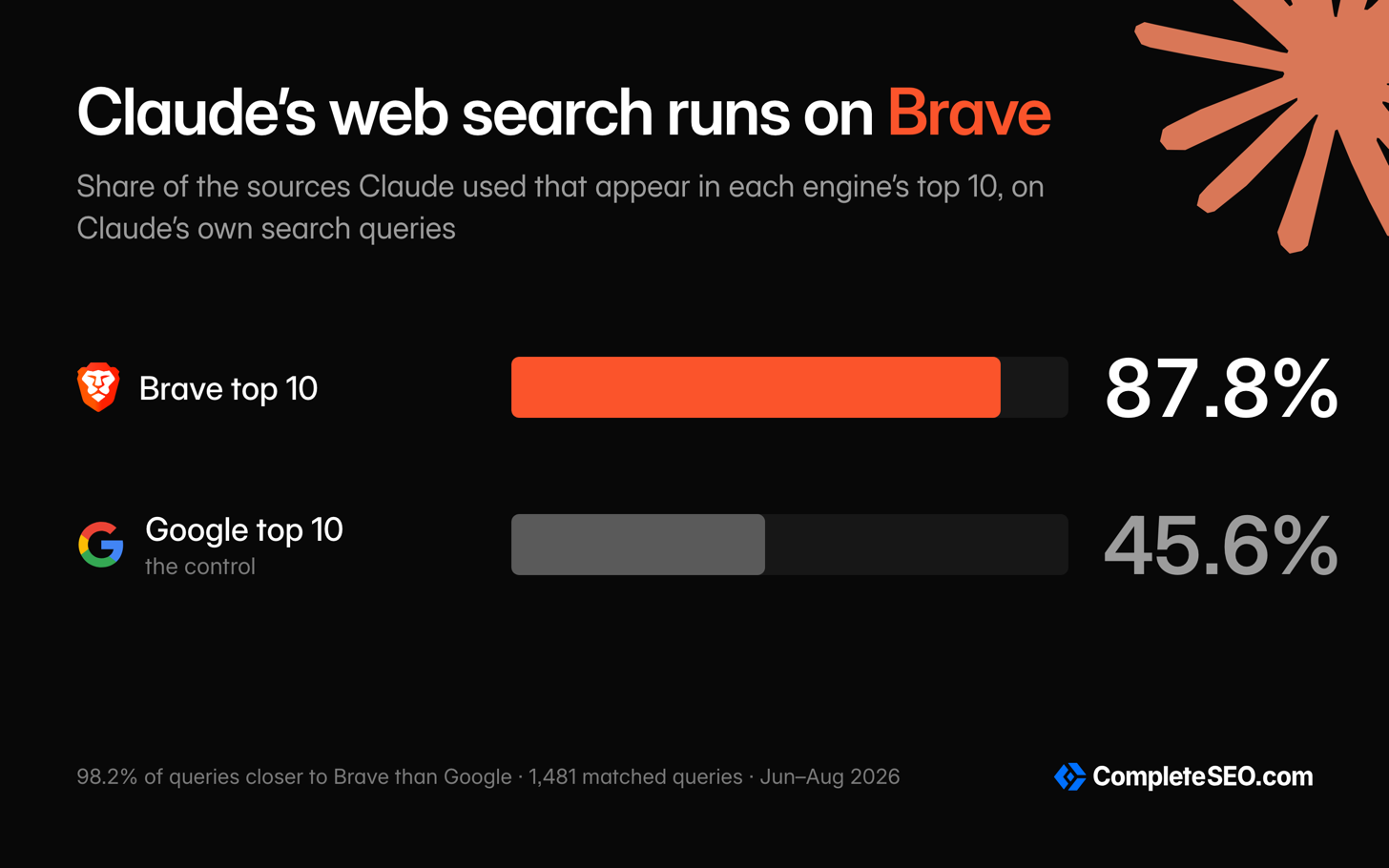
Anthropic's product doesn't disclose where Claude's search results come from. Brave had emerged as the probable provider in 2025 reporting after it appeared on a list of companies Anthropic calls subprocessors. We wanted a large-scale measurement of our own, using real buyer-intent queries and repeating the work over time so we could catch a change.
Why this is measurable at all
When Claude answers with web search on, its API response includes the answer and the precise query strings Claude composed for itself. It also includes the precise URLs retrieval returned before any selection. Both halves of the system are visible, so we don't have to work backward from citations or guess what the model saw.
That visibility lets us compare Claude's retrieval with Brave and Google on identical queries. We take each of Claude's reformulated queries and send the identical string to Brave through its search API and to Google for organic results, then compare the three URL sets. Each query is matched one to one.
The control matters more than the headline
Because overlap between any two search engines is normal, we ran every query against Google organic as a floor to see how often Claude's sources appeared there as well as in Brave. Across the same 1,481 matched queries, Brave's top 10 held 87.8% of Claude's sources, compared with 45.6% for Google. On 1,455 of those queries (98.2%), Claude's source set was closer to Brave's than to Google's. The gap between Brave and Google held steady across the account base's three full monthly sweeps, from June through August, with no significant drift between sweeps.
Those matched queries came from a larger corpus of client AI answer runs that we collect continuously. Since late May, it has included 44,635 AI answer runs across six engines, 5,397 of them Claude runs with search enabled. That gives a sense of scale, but the 87.8% figure comes only from the 1,481 queries where all three engines returned comparable result sets.
Brave rank predicts whether Claude cites you
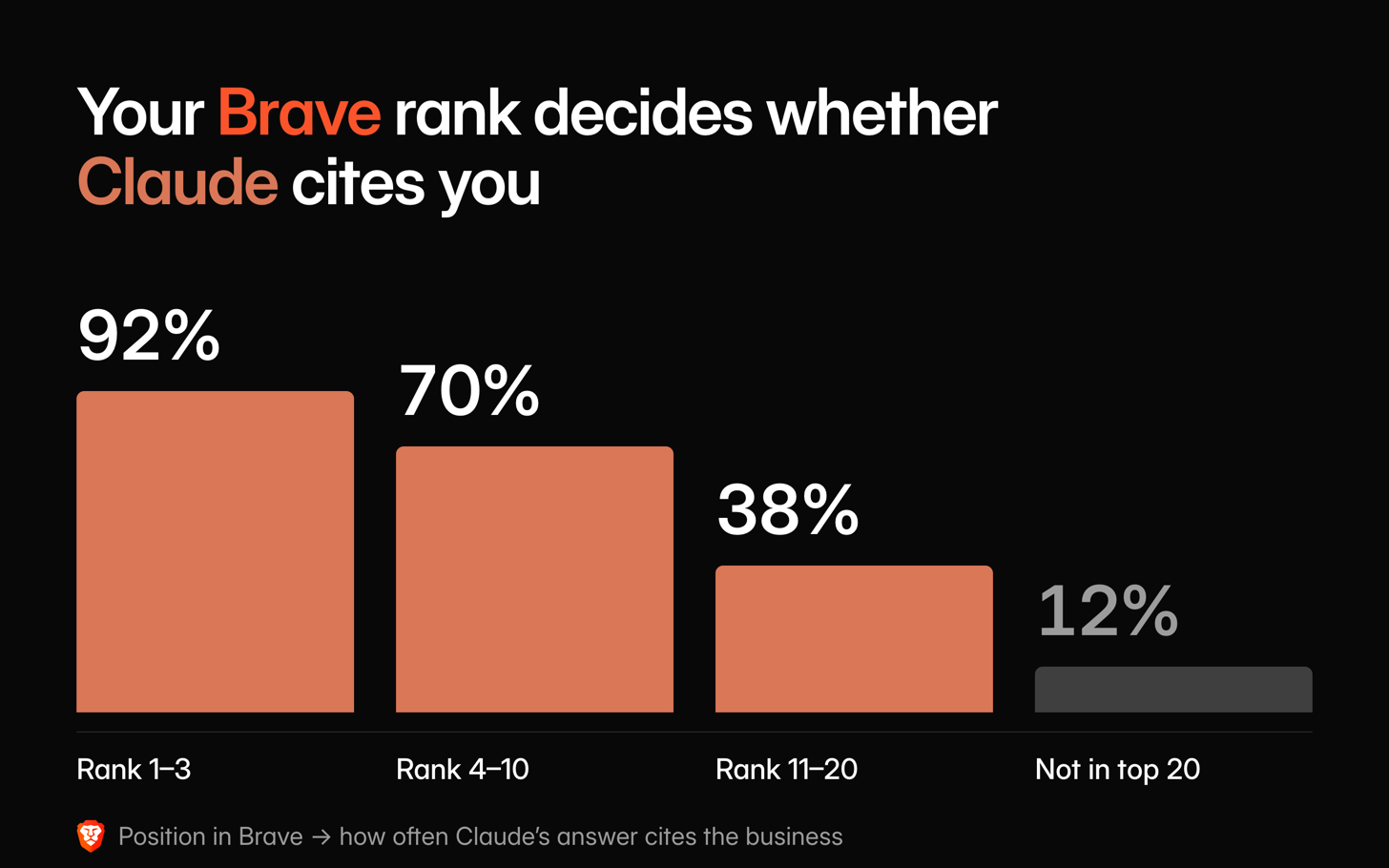
The retrieval result is interesting, and the citation result gives your business something to act on. For each tracked prompt, we recorded the client's Brave rank for that query and whether Claude cited the client in its grounded answer. The citation rate falls sharply as Brave rank drops.
| Brave rank | Cited by Claude |
|---|---|
| 1–3 | 92.0% |
| 4–10 | 69.8% |
| 11–20 | 38.4% |
| Not in the top 20 | 11.9% |
Across the same 52 accounts and 1,408 prompt observations, clients ranking 1 to 3 in Brave had a 92% citation rate in Claude's grounded answers. Clients absent from Brave's top 20 had a 12% citation rate. If you want Claude to recommend your business, rank in Brave. Earning rank in Brave takes the same work as earning it in Google.
Two different problems that look the same
When you can see retrieval and citation separately, a business missing from Claude's answers has one of two problems. If the business is absent from Brave, it's a ranking problem, and ordinary SEO is the fix. If the business ranks in Brave but Claude doesn't cite it, it's a selection problem. Claude sees the page and skips it, so the fix is content and entity work.
Across our clients, we've found 218 ranking gaps and 56 selection gaps, with 38 of 55 accounts leaning ranking-first. The typical business asking how to get into Claude has an ordinary ranking problem that looks like something new and scary. That's good news for you because the industry already knows how to fix ordinary ranking problems.
The measurement almost fooled us once
Our primary overlap score dropped sharply between our June and July measurements, the kind of change we'd expect if Claude had switched providers. Claude had started returning fewer sources per query while Brave's and Google's source counts stayed flat, and the score we'd been using fell on set size alone because it divides by the combined size of both sets. Our containment measure, the share of Claude's sources found in Brave's top 10, held completely steady over that window, and we now watch and publish it after it came through its own false alarm intact. If a vendor shows you an overlap statistic, ask which kind it is.
This is the first study in a series from our AI visibility tracking work. Every month, we measure how real businesses appear on Claude, ChatGPT, Gemini, Perplexity, and others against real buyer-intent prompts. Talk to us to learn where your business stands before your competitors figure this out.