
100+ Five-Star Reviews
AI SEO services that get you named when buyers ask AI
We build the visibility, credibility, and trust your business needs to be the answer.






The problem
Why does AI recommend my competitors instead of me?
When someone asks an AI engine who to call, a handful of businesses get named. The person asking has already done their comparing, and buyers who arrive that way convert at roughly twice the rate of your other traffic. Whoever gets named gets the call, and we work to make sure it is you.
I could not find a builder by that name in Austin. There is a Redbud Builders & Remodeling in Vermont.
You may be waiting until Monday for a callback. They are generally closed on weekends.
Based on reviews, directories, and listings, I recommend Competitor 1, Competitor 2, and Competitor 3.
- 01
Ask an AI about your company by name and it has nothing, or it hands you a business with a similar name two states away.
- 02
It knows you, and what it says about you is out of date, incomplete, or invented.
- 03
It knows you and it still names somebody else, because the sources it trusts all back them up and none of them mention you.
“The businesses that move first and dominate AI answers over the next two years win the same advantage as those that took search seriously in 2005.”
 Ryan HowardFounder, Complete SEO
 Framework
How we make your business the answer
An AI answering a buying question leans on sources it trusts. We build a content and citation growth system so AI engines serve your business when customers are looking for the services you provide.
- Build your web presence into a trust network so AI engines see the signals they need to include your business in AI answers
- Publish content that answers the exact questions a buyer asks, plus reviews and credentials, so the AI model can credibly pick your business
- Track citations across ChatGPT, Gemini, Claude, Perplexity, and Copilot to know which sources will maximize your visibility
What actually works
How we get our clients visible in AI search
We rely on data to drive the decisions and activities we run each month. Every change we make gets logged against the month it went live, so the next measurement tells us which ones moved your rate and which did nothing.
Getting the AI crawlers in
Making sure GPTBot, PerplexityBot, ClaudeBot, OAI-SearchBot, and other important AI crawlers can reach your pages is the first thing we check on every AI audit, and it's broken far more often than owners expect.
Making your facts agree everywhere
Hours, address, phone, service list, and price ranges need to align on your site, in your Business Profile, and across the listings a model reads. When a model can't find a fact stated plainly in text, it provides an inaccurate answer based on external sources and hallucination.
Getting corroborated off your own site
An AI trusts what other sites say about you more than what you say about yourself. We get your business described accurately across the directories, review platforms, and trade associations a model checks, so the sources behind the answer back you up.
Publishing the answers your buyers actually ask
An AI engine breaks questions into one or two searches of its own and answers from those results. We recover those searches to learn what the engine decided your buyer was asking, and then write content that also answers those questions.
Earning mentions where buyers compare
AI engines cite community and review sites alongside a business's own website. We look at your entire retrieval set, the pages an engine pulled from to build its answer, and work the ones carrying the competitive questions that turn into leads and booked jobs.
Measuring it every month
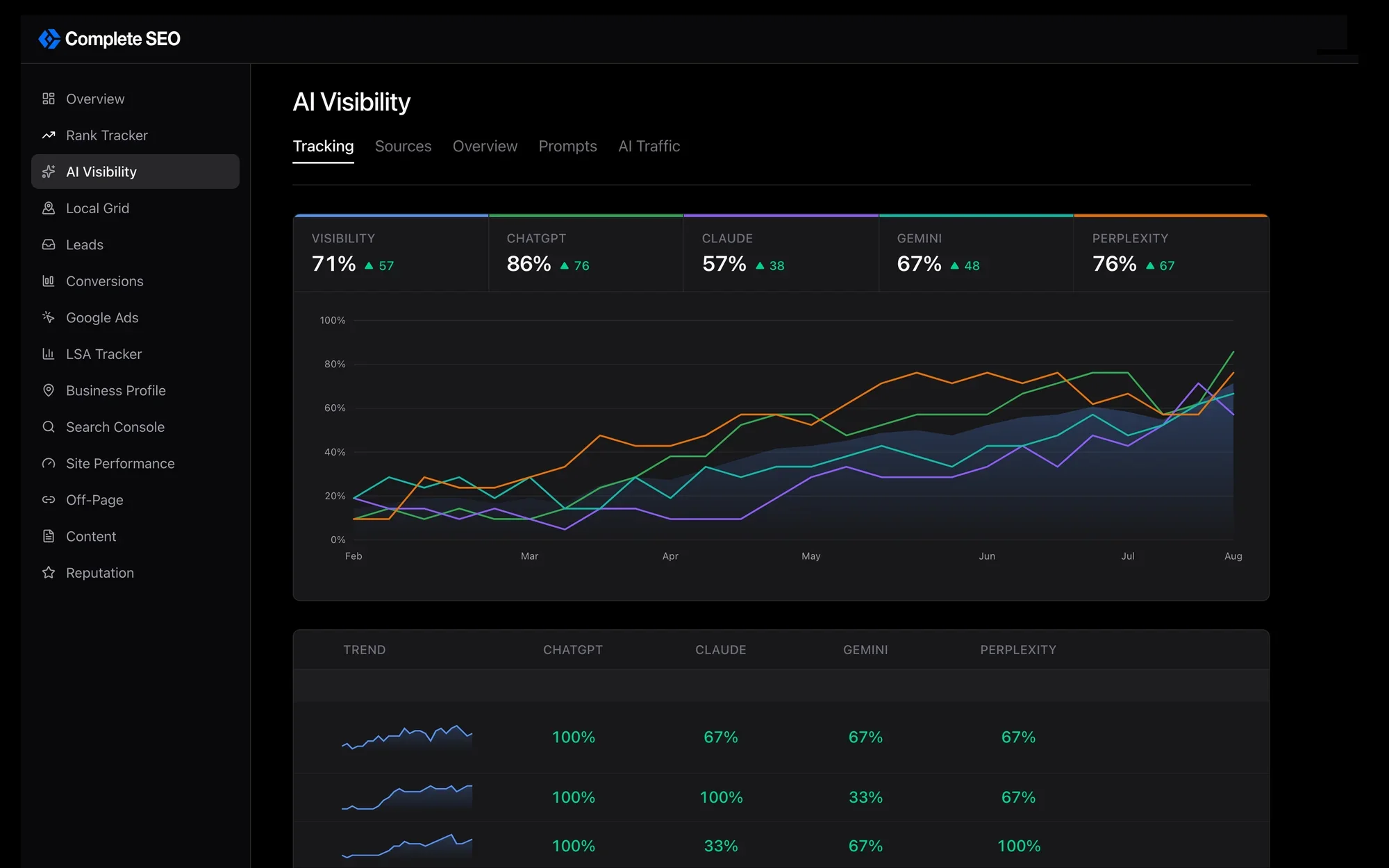
We look at how often you show up against your competition, track your recommendation rate and share of answers over time, and dig into the answers where competitors are cited and you are not. What is missing from those becomes the plan for the following month.
Reporting
What we track
Most agencies are still working out what to even look at. We report the same five numbers every month, and the next month's work is aimed at whichever one is not moving.
- Share of the answers that name your business
- How often you are cited and from which sources
- Branded search lift and brand perception
- AI referral traffic arriving on your site
- Leads traced back through the whole chain
Original research
How AI search decides which local businesses to recommend
We've been running our own AI search experiments since 2024, tracking tens of thousands of answers to see which local businesses get recommended and why. The same research shapes the work we do for clients. These three are the place to start.
How AI search works
How ChatGPT and other AI engines find, cite, and name local businesses, and what to do about it.
Read the guide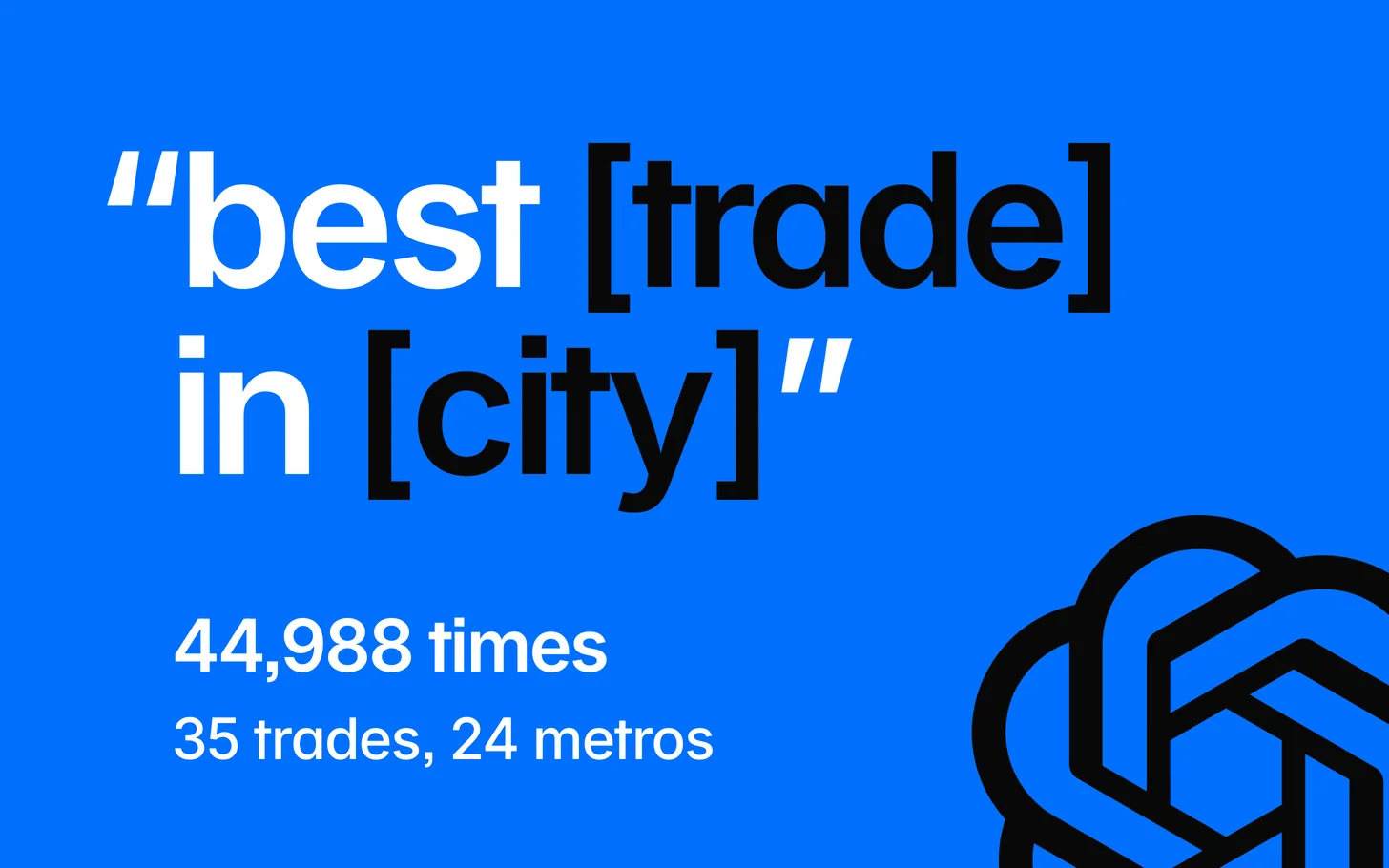
Study: 44,988 ChatGPT local answers across 35 home service trades and 24 metros
What ChatGPT's card, its ratings, and its lists of businesses look like when it's asked for the best [trade] in [city].
Read the study
Anatomy of a ChatGPT local answer
One Austin question followed through the raw data a logged-in browser receives, step by step.
Read the breakdownCommon questions about AI search optimization
How do I show up in ChatGPT?
Is this generative engine optimization? What about answer engine optimization?
Is this different from regular SEO, or the same thing with a new name?
AI search adds a whole new layer on top of SEO. Google's guidance says optimizing for AI results still counts as SEO, and the SEO fundamentals have to be in place.
The same prompts asked in ChatGPT, Google AI Overviews, Gemini, Claude, Perplexity, and Copilot bring back different responses, each based on different cited sources. We analyze data across industries and track the sources behind searches that matter to your business. Both steer our strategy and our work month to month.
Does this mean writing a page for every question someone might ask?
No. That pattern actively backfires. When an engine answers a buying question, it usually runs one or two searches of its own using terms different from the question as asked, then builds an answer from those results.
We can recover those sub-queries to see what the engine took the question to be about. That regularly differs from what a keyword tool would suggest, so we use the sub-queries to decide what's worth writing. Google has been deindexing sites for scaled content. Mass-producing a page for every question and every city fits that pattern and fails to get you into AI answers.
Can you guarantee ChatGPT will recommend my business?
How do you work out why AI is not naming us?
We question the engines directly about you with web search off to see what they know unaided. If they can't describe you unless they look you up, the material the models learned from didn't include you. In that case, we build a presence the engines can find. If they can describe you and still name a competitor, we give them a reason to choose you.
Those two gaps call for different work and take different lengths of time. We pin down which gap you have first so a month doesn't go to the wrong fix.
How long does it take?
How do you decide which questions to measure?
Which engines do you track, and why not my position inside the answer?
We track ChatGPT, Gemini, Claude, and Perplexity, and we don't report your position within an answer because we haven't found a stable position to report. Asking the same question repeatedly brings back different businesses in a changing order. This happens often enough that one run on its own says very little.
That's why we run every question several times on each engine in both channels and report your recommendation rate, the share of answers naming you. Right now we're measuring how much of the movement from one run to the next is ordinary noise so we can tell the effect of our changes apart from it.
Do I still need this if I rank well on Google?
100+ Five-Star Reviews
We find the gaps and why you're losing leads to competitors
We show you precisely how your company appears at every point where a customer is deciding who to trust, and tell you exactly what needs to change.
Free Visibility AuditSee exactly how your company shows up, and what to fix first.