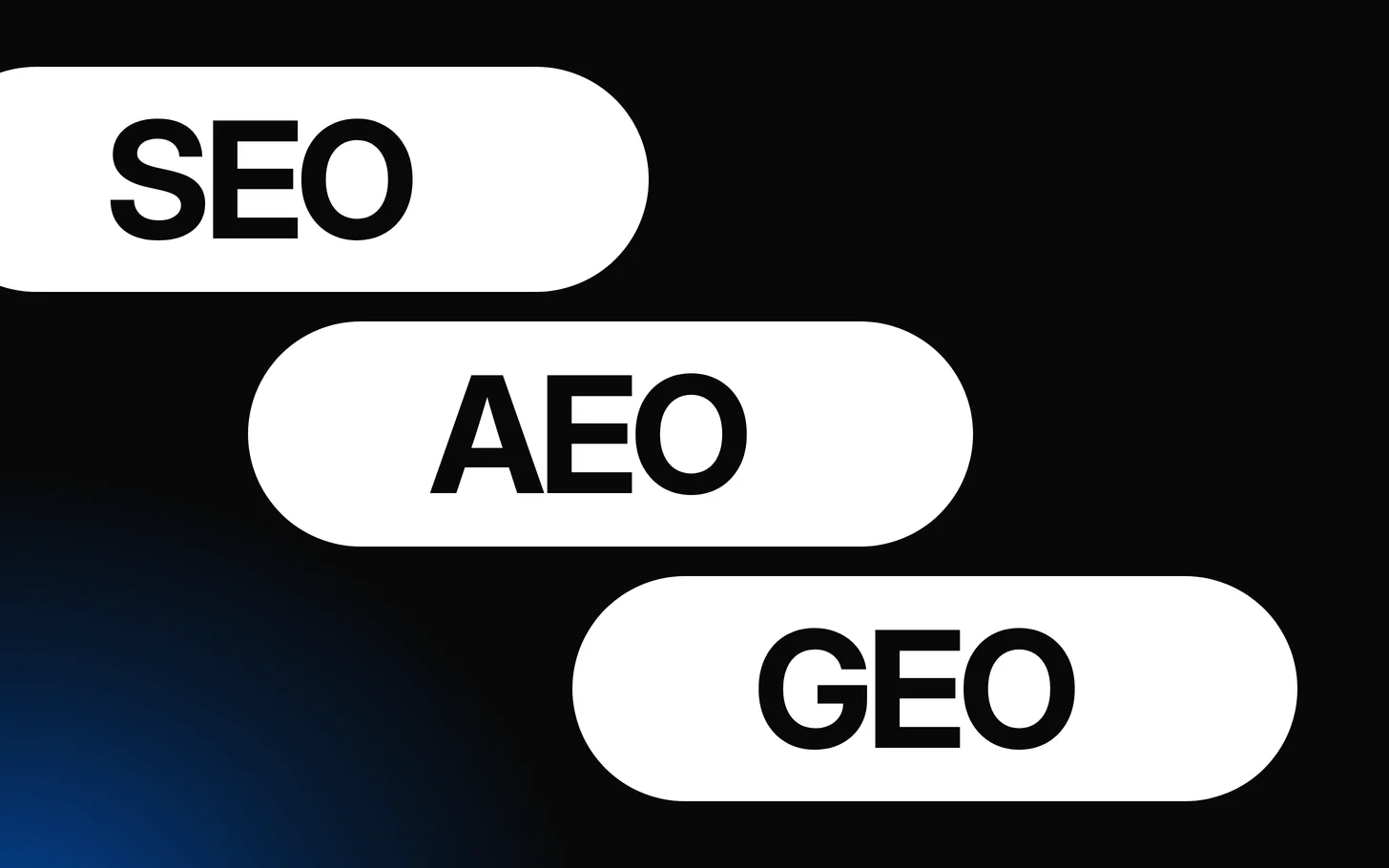
- AEO (answer engine optimization), GEO (generative engine optimization), and AI SEO are three names for one job. That job is getting an AI tool to name or cite your business when someone asks it a question.
- That work builds on SEO and reaches beyond it. Google considers it part of SEO, while other AI engines cite different sources and send their own crawlers to read your site.
- AEO is the older name, already in use by 2018 for featured snippets and voice assistants. GEO traces to a research paper first posted in 2023.
- The biggest change is measuring how often a business gets named. Across 188,520 pairs of repeated asks, both ChatGPT answers in a pair named the same set of businesses in 3.6% of cases. So we track the rate a business gets named and never report a position.
- Your listing now has another place to appear. Our analysis of 27,405 local answers found that 95% included a ChatGPT card, and every row on that card carried listing details.
- The AI work needs an owner. Your current SEO agency can take that role if it tracks each engine separately and gives you the share of answers naming your business, with a range.
What do GEO, AEO and SEO mean?
SEO, AEO and GEO describe the work of getting found across different kinds of search, with GEO, AEO and AI SEO naming the same job for AI answers that builds on SEO. SEO (search engine optimization) dates to the 1990s. Google's starter guide defines it as "helping search engines understand your content, and helping users find your site."
AEO (answer engine optimization) came later. By February 2018, Search Engine Watch used it for a strategy aimed at engines where one answer takes the place of a results list, including voice assistants and Google's featured snippets. We've found no primary source that establishes where the AEO term began.
GEO (generative engine optimization) takes its name from a research paper first posted in November 2023 and accepted to the KDD conference in 2024. The paper coined the term for raising a page's visibility in answers written by AI models. The paper's tests used a simulated engine running OpenAI's GPT-3.5 Turbo to answer each question from five search results chosen in advance, then scored each page by how much of the answer drew on it. Our guide covers what the paper found and why those findings tell a local business little about getting picked.
Google's guide describes AEO and GEO as "terms you may see used to describe work specifically focused on improving visibility in AI search experiences." In Google Ads data pulled via DataForSEO in September 2026, average monthly US Google searches were about 6,600 for "ai seo" versus 4,400 for "generative engine optimization" and 2,400 for "answer engine optimization."
| Name | What the name puts first | Where the answer shows up | How success gets counted |
|---|---|---|---|
| SEO | Helping search engines understand your content and people find your site (Google) | Search results, which on Google include AI Overviews and AI Mode | Rankings, clicks and impressions. Search Console now reports impressions in Google's AI features too |
| AEO | Being the one answer an engine gives (Search Engine Watch, 2018) | Voice assistants and featured snippets in 2018, AI tools now | Being the answer, or being cited in it |
| GEO | Visibility inside answers an AI model writes (the 2023 paper) | ChatGPT, Gemini, Perplexity, Copilot and Google's AI features | The paper measured how much of an answer drew on a page. For a local business we count how often it's named, with a margin of error |
| AI SEO | The same job under a plainer name | Same as GEO | Same as GEO |
Is GEO different from SEO?
Yes. GEO and AEO are two labels for the same job, which starts with SEO and adds work Google rankings don't cover. Google classifies it as SEO, and its guide to AI features says, "From Google Search's perspective, optimizing for generative AI search is optimizing for the search experience, and thus still SEO." A June 2026 Think with Google piece puts it more loosely, saying "good SEO is good GEO (or AEO, or AI SEO, or whatever)."
Google's description applies to its own search, while customers also ask questions on other engines. Claude's web search is powered by Brave, as we found in our ten-week Brave study. Across 1,481 matched queries from June to August 2026, 87.8% of pages retrieved by Claude's search tool ranked in Brave's top 10 for the query, while 45.6% ranked in Google's top 10. A strong Google ranking doesn't ensure a page is among those Claude reads.
Microsoft keeps GEO as a distinct label in its Bing webmaster guidelines, which say SEO best practices help a site be seen on Bing, on Copilot and in AI-powered search, while GEO centers on "content eligibility for grounding and reference in AI responses." The guidelines use "grounding" for the step that ties an AI answer to the web pages it pulled. Microsoft describes the Bing Webmaster Tools AI Performance report as "an early step toward Generative Engine Optimization (GEO) tooling". OpenAI's publisher FAQ uses neither GEO nor AEO and advises allowing OAI-SearchBot, its search crawler, to reach the site for ChatGPT search visibility.
Ordinary search rankings and mentions in AI answers are different outcomes built on the same foundation. On local questions, ChatGPT answers contain the same things local SEO already builds. In our census of local answers, gathered Sept. 3 to 7, 2026, 95% of the 27,405 answers in the main analysis showed a card of businesses, and each row had the shape of a listing, with a name, address, phone number and category. Links cited next to those cards were mostly business websites and directories.
We asked ChatGPT "what's the difference between SEO and AEO" in three separate sittings on one ChatGPT Plus account on Sept. 24 and 25, 2026. Each time, it skipped web search and said AEO "isn't really a replacement for SEO."
What AI search adds
AI search brings a new way to keep score, sources that vary by engine, and searches the engine writes. It also brings AI crawlers and a new place where customers see your listing.
Keeping score. An AI answer has no fixed list for your business to rank in. In our repeat study, gathered Aug. 24 to 27, 2026, the same local question asked twice, minutes apart, produced the exact same set of named businesses in 3.6% of 188,520 pairs. We count naming frequency across asks, wordings and days, then give that rate with a band for its natural swing. Why the answer keeps changing covers changing answers, and how to run AI visibility tracking covers our tracking method.
Sources vary by engine. Each engine favors its own blend of sites, as an August 2026 cross-engine run showed. Yelp.com was cited in 33.2% of Claude's answers and 29.3% of Perplexity's, and in none of 2,560 ChatGPT answers. The ChatGPT census found Angi cited in 16.5% of 41,160 answers in its main arm. Among answers with a card, business websites accounted for 56.5% of cited links and directories for 29.9%. The directories cited for your trade in your town give you a checklist of where to be listed, and the directory section covers them.
The listing card. The card appeared in 95% of 27,405 local answers in the census main analysis, a different base from the 41,160 answers counted for Angi, and gave customers a new place to see listing details. The card's business identity follows Google's listing data. Its star ratings agree with Yelp's for more businesses than with Google's, though Yelp never reaches a majority. Our guide's section on local sources covers how a Yelp profile can appear in ChatGPT whether or not its owner manages it.
Searches behind the question. OpenAI says ChatGPT "typically rewrites your query into one or more targeted queries." Your pages need to match the searches the engine composes, even though the customer never typed them. Our guide's section on query fan-out shows what ChatGPT searches for.
AI crawlers. AI companies operate crawlers of their own, and OpenAI says that once a site opts out of its OAI-SearchBot crawler, it "will not be shown in ChatGPT search answers," though links that help users reach the site remain possible. Google's AI features rely on ordinary Googlebot, so the rules you set for Googlebot in robots.txt govern them too. In our access census of 15,834 live local business websites, gathered Aug. 20, 2026, 23.77% couldn't be read by one or more of the 11 AI crawlers we tested, and after weighting to match the full sample's makeup, the figure was 27.06%. Checking your own site takes a few minutes.
What carries over from SEO
Pages crawlers can read, a correct listing, plain facts on your site, and mentions you've earned remain the foundation. Google's SEO-basics checklist for AI features includes "Ensuring that crawling is allowed in robots.txt, and by any CDN or hosting infrastructure," "Making sure that important content is available in textual form," and a current business listing. Separately, Google's optimization guide says listings can help a business "be visible in both AI responses and other Google Search results." The same guide says, "You don't need to write in a specific way just for generative AI search."
Google says its AI features can surface what people say about products and services online, "including in blogs, videos, and forum discussions," so earned mentions still matter. Google also warns that "seeking inauthentic "mentions" across the web isn't as helpful as it might seem." We share the evidence we found in our guide's section on links and mentions.
Certain tactics sold as AEO or GEO work can be skipped on Google Search, as Google's guide makes clear when it says, "Prioritize effective SEO strategies over "AEO/GEO hacks"." For Google Search, it says you can ignore content "chunking," AI text files such as llms.txt, and inauthentic mentions. Google also says there's "no special schema.org markup you need to add." That advice applies to Google only, and our guide covers the other engines in its sections on llms.txt and schema markup.
Do I need a separate GEO or AEO agency?
AI search needs an owner, and your current SEO agency can fill that role if it does the AI work. Ask how it tracks every engine, which cited sites it's working on for your trade in your town, and whether its reports show the share of answers naming you with a band. Rankings and clicks alone can't show how often ChatGPT names you. Our guide's section on paying for AI SEO has the full list of questions to ask.
Our AI SEO services handle GEO, AEO and AI search optimization as one job. Our reports give the rate you get named, and we never report a position within an answer.