- ChatGPT ads are paid sponsored cards below an answer. Advertisers have no say over the answer itself.
- Free and Go users see them, while paid-plan users don't. As of October 2026, self-serve buying is open to businesses in more than 60 countries.
- There's no keyword bidding. OpenAI matches ads to conversations using advertiser-written context hints and a relevance-weighted auction.
- In the US, you can target ZIP codes or a metro market, enough to draw a local service area.
- OpenAI suggests starting bids of $3 to $5 per click. Still, published results vary widely.
- Tracking is the hard part. Untagged ad clicks appear as Direct in Google Analytics, and phone leads don't reach OpenAI unless call tracking keeps the click ID.
What are ChatGPT ads?
ChatGPT ads are paid placements OpenAI puts below a ChatGPT response, marked as sponsored and visually separate from the answer. OpenAI keeps its ad systems separate from the chat model and says advertisers "have no ability to shape, rank, or alter ChatGPT's responses." Advertisers receive only aggregate performance numbers, such as views and clicks, and can't access anyone's chats.
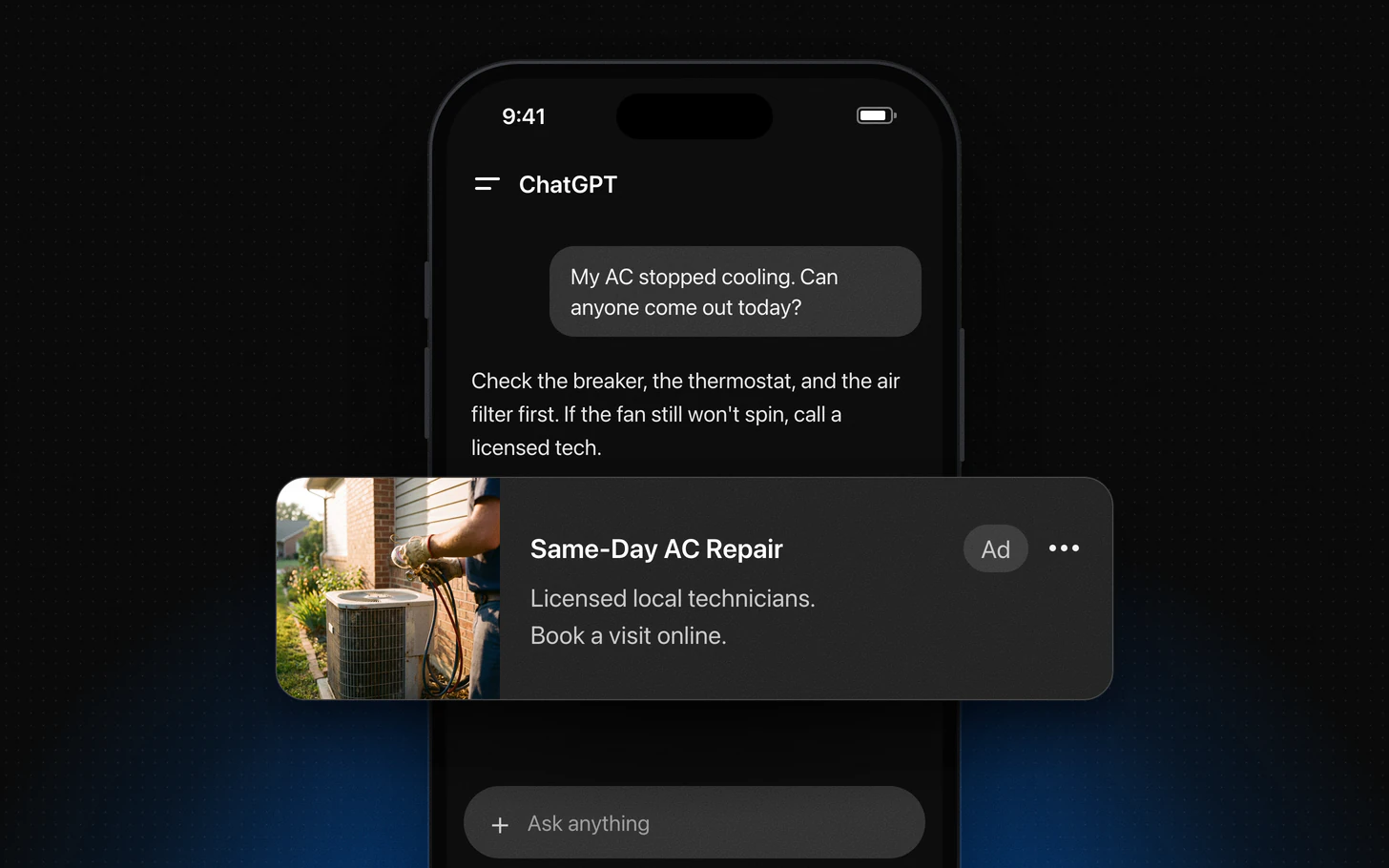
OpenAI started testing ads in the US on February 9, 2026, and opened its self-serve Ads Manager in May 2026. On August 31, 2026, OpenAI said its ads business had reached a $1 billion annualized revenue run rate in under 200 days. Ads are still in beta, and OpenAI expects delivery, formats, and measurement to keep changing. Current details are in OpenAI's help articles.
Who sees ChatGPT ads?
ChatGPT ads appear for Free and Go plan users. Accounts on Plus, Pro, Business, Enterprise, and Edu plans don't see ads, and neither do accounts OpenAI identifies as under 18. Ads also don't appear in Temporary Chats, and Free users can choose an ad-free option with lower usage limits. OpenAI reported in October 2026 that ChatGPT reaches 1.2 billion people each week, but businesses can buy ads to reach only the ad-eligible share of those people.
Many professionals are on paid plans, so business-to-business advertisers can't reach them through ChatGPT ads. As of October 2026, self-serve Ads Manager is available in more than 60 countries, and that page keeps the current list. The business placing the ad and receiving the bill must be based in one of those countries.
What do ChatGPT ads look like?
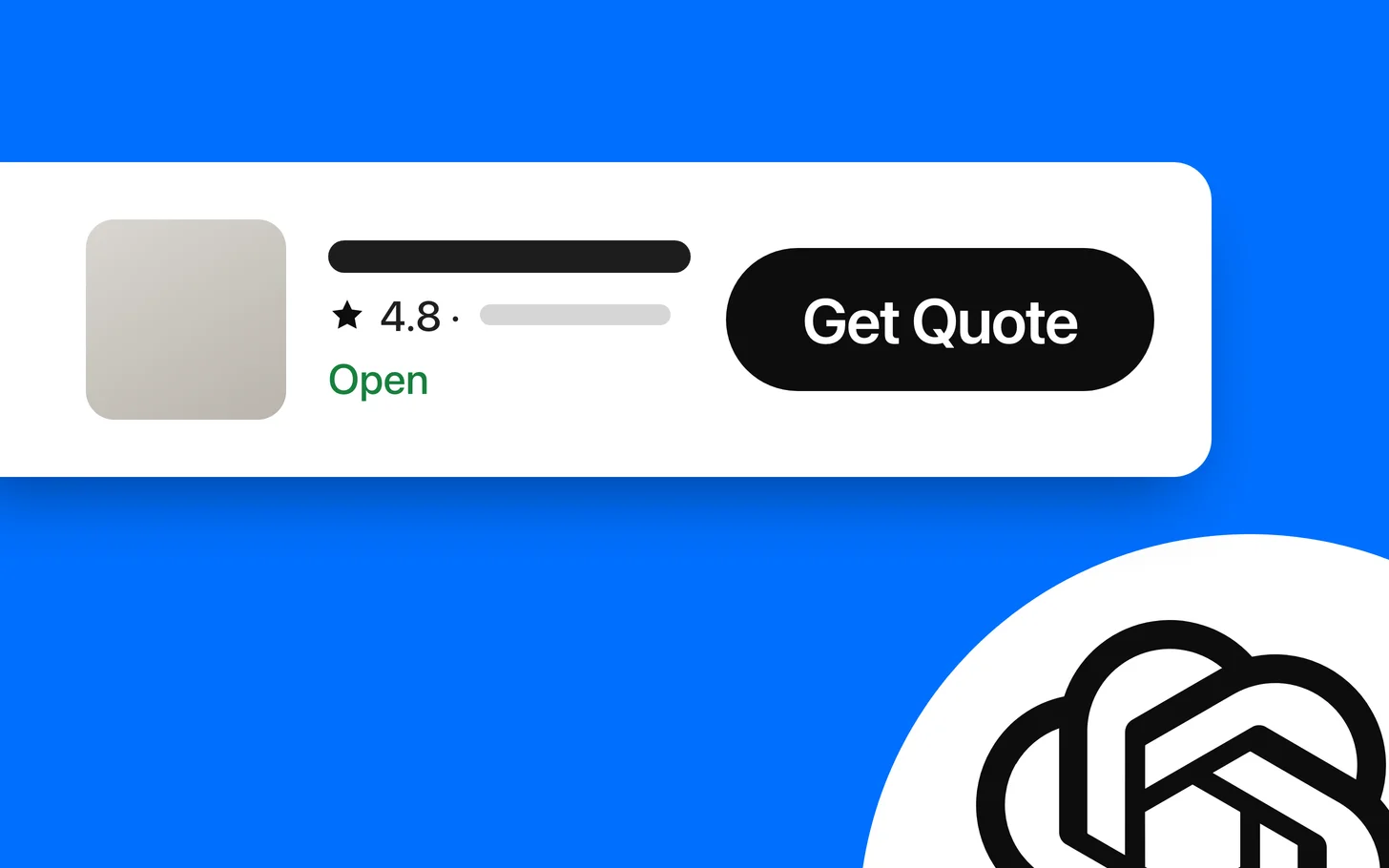
A standard ChatGPT ad is a compact card with the advertiser's name and logo, a title, a short description, a square image, and a link to a landing page. The recommended title length is 16 to 24 characters, with a maximum of 50. The description has a recommended length of 32 to 48 characters and a maximum of 100. The image must be a square PNG or JPG, up to 1,200 by 1,200 pixels.

As of October 2026, Sponsored Agents are in testing. From an ad, a user can open a clearly marked conversation with the advertiser's AI agent. Angi says it's one of the earliest pilot brands. An October 2026 announcement described a multi-image ad shown during ChatGPT image generation, with a US test starting with a small group of advertisers.
How does ChatGPT decide which ad to show?
OpenAI considers what the conversation is about and what the person wants, along with the ad's title, copy, and landing page. It also considers the advertiser's context hints and targeting, plus information from that user's past chats when personalization is on. Ads enter a relevance-weighted, second-price auction, so a bigger bid alone doesn't guarantee the win.
Context hints take the place of keywords. Set per ad group, they're short descriptions of situations where the offer helps. OpenAI says they "are not exact-match keywords or targeting rules, and they do not guarantee delivery for particular conversations or audiences." A weak hint like "AC repair" gives the system little to go on, while a strong hint like "Homeowner whose central air stopped cooling in hot weather and needs a licensed local technician the same day" describes a moment the ad can answer.
OpenAI advises building each ad group around a single service, product category, theme, or customer need. A roofer would put storm-damage repair and new-roof estimates in separate ad groups. Qualifying advertisers can use Negative Phrases to keep ads out of contexts that don't fit their brand.
Can you target ChatGPT ads to your service area?
Yes, you can target your service area. We downloaded OpenAI's location catalog on October 18, 2026, and counted 41,488 ZIP codes, 210 metro markets, and 57 states and territories in the US, although the catalog also lists postal codes in other countries. "Austin, TX" is one of the metro markets. The catalog has no city type or radius type, so a local service area is a set of ZIP codes or a metro market.
You can also exclude locations. Target only areas you serve, because OpenAI's policy says advertisers "may not misrepresent their business location, service area, or eligibility."
Custom audiences built from customer email or phone lists require at least 25,000 matched users to target or adjust bids, and most local businesses won't reach that threshold. You can still use smaller lists to exclude past customers.
How much do ChatGPT ads cost?
Reach campaigns are billed per 1,000 impressions, while Clicks campaigns are billed per click. Conversions campaigns aim for an event, such as a lead, and are billed per click or, for eligible advertisers, per 1,000 impressions. There's no per-conversion billing. For Clicks campaigns, OpenAI recommends starting with a maximum bid of $3 to $5 per click.
As of October 2026, the US minimum daily budget is $25. At launch, reported pricing was about $60 per 1,000 impressions with a $200,000 minimum commitment. Trade press reported that the minimum fell to $50,000 in April and was dropped when self-serve opened in May, so older articles quoting that commitment are out of date.
Your daily budget is an average, so spending on a single day can reach twice that amount. Across a Sunday-to-Saturday week, spending is capped at seven times the daily budget.
Outside numbers vary widely. An agency roundup of published results from 15 US campaigns found a median of $4.41 per click, while a legal marketing agency reported $20 to $40 per click.
How do you set up a ChatGPT ads campaign?
Create an account at ads.openai.com, complete business verification, and add a payment method. Then set your objective, budget, dates, locations, and platforms at the campaign level. Each ad group has one theme, its context hints, and its bid. Each ad has its creative and landing page. Before launch, OpenAI reviews the advertiser, ad, and landing page.

Your landing page should pick up where the conversation left off. If someone asks about a flooded basement, send them to your water extraction page. OpenAI advises linking to the closest-matching service, product, or content page over a generic homepage.
OpenAI requires advertisers to allow OAI-AdsBot. It checks landing pages against OpenAI's policies and reads them to judge when the ad is relevant. OpenAI also recommends allowing OAI-SearchBot. The robots.txt allow rules are:
User-agent: OAI-AdsBot
Allow: /

User-agent: OAI-SearchBot
Allow: /
Allowing OpenAI's bots in robots.txt doesn't guarantee that they can reach your landing page. Firewalls, CAPTCHAs, bot challenges, and login walls can block the crawler even when people can see the page fine. OAI-AdsBot is on Cloudflare's verified-bot list.
How do you track leads from ChatGPT ads?
Every ChatGPT ads discussion gets to return on investment (ROI), and only measurement set up before you buy traffic can answer that question. That measurement must show where your AI traffic comes from and which visits turned into calls or form leads.
OpenAI's Pixel runs in the browser, its Conversions API handles events sent from a server, and you can add UTM tags to the final URL so Google Analytics can identify ad clicks. Each ad click adds an oppref parameter to the landing page URL, and the Pixel saves oppref in a first-party cookie so a form submitted later still gets credited. If you send the same conversion through the Pixel and Conversions API, use one shared event ID so OpenAI drops the duplicate. Lead-type standard events include lead_created and appointment_scheduled, among others, and attributed conversions take 24 to 48 hours to appear in reporting.

Set up three things before launch. First, add UTMs to the final URL because ad clicks carry no referrer and otherwise appear in Google Analytics as (direct) / (none). Second, one fixed tracking number for every visitor can't tie a call to a specific click, so use per-visit (session) call tracking that carries the oppref, plus a Conversions API event with phone call as its source. Third, check that your lead event is set on the real thank-you URL your forms use, and screen calls before counting them as leads because hang-ups and voicemail greetings pad a call count.
To see ad cost next to leads, pull OpenAI reporting into your own dashboard or analytics with an Advertiser API key. In Ads Manager, go to Settings → General → API Keys, then Create New Key, and keep in mind that each key covers one ad account. We use an Advertiser API key so our own client dashboard pulls ChatGPT ads spend, clicks, and conversions daily. Get a separate Conversions API key in Ads Manager's Conversions section to send server-side events such as phone calls, and keep both keys on a server because the browser Pixel needs no key.
Which businesses can't advertise on ChatGPT?
OpenAI's ad policies prohibit political ads, adult content, alcohol, tobacco, intoxicating substances, and weapons. They also prohibit ads for a single job listing or a single home for sale or rent. The policy names local services among its supported consumer categories.
As of October 2026, some regulated categories are open in the US under conditions:
- Lawyers: Since August 2026, lawyers have been allowed to advertise in the US if they're licensed where the ad appears.
- Health: In the US, health advertisers, including dental services, are approved case by case. Minimally invasive cosmetic procedures are allowed, hospitals and urgent care are limited to approved advertisers, and telehealth isn't allowed. Ads are never placed beside mental or personal health chats.
- Financial services: Approval is case by case, with deposit accounts, insurance, and auto loans allowed in the US. Credit cards, mortgages, and investing are limited to approved advertisers, while credit repair and debt relief are banned.
OpenAI changes these rules often, so check its current eligibility table before building a campaign.
Do ChatGPT ads help you show up in ChatGPT's answers?
No. An ad doesn't buy a mention or citation in the answer above it. Our September 23 test found ads on 10 of 16 local answers for a signed-in Free account. Six of the 10 ads were for the lead marketplaces Thumbtack and Angi, and the other four were for brands and local businesses, including an HVAC company in Austin and a plumber in Raleigh. Only one of the 10 advertisers also appeared in ChatGPT's unpaid business list below its ad.
Getting into the answer is separate SEO work. You need clear service pages, consistent business facts, and third-party proof ChatGPT can find and trust. That's the work we do through our AI SEO services, with a longer explanation in how AI search works.
AI visibility tracking tools can miss ads completely. A few hours after our capture, DataForSEO's scraper reported zero ads for the same 16 questions.
Are ChatGPT ads worth it for a local business?
Yes, ChatGPT ads are worth a small, controlled test for a local service business if your category is allowed, you have a landing page for the exact service, and your tracking catches forms and calls. In an OpenAI case study, Angi's return on ad spend rose more than 38% in Q3 compared with Q2, and its cost per lead has fallen 34% since it began conversion-optimized campaigns. Outside OpenAI's case studies, results are mixed. The same agency roundup found that Google converted better in 4 of 4 cases where one advertiser ran both.
Fund the test from a new budget, and keep Google Search and Google Maps running while you test. Give it about 90 days, judge it by qualified leads and booked jobs, and raise spend only if those results hold up. Thumbtack and Angi already buy ads on local questions, so testing also lets you see the ChatGPT experience your customers get.