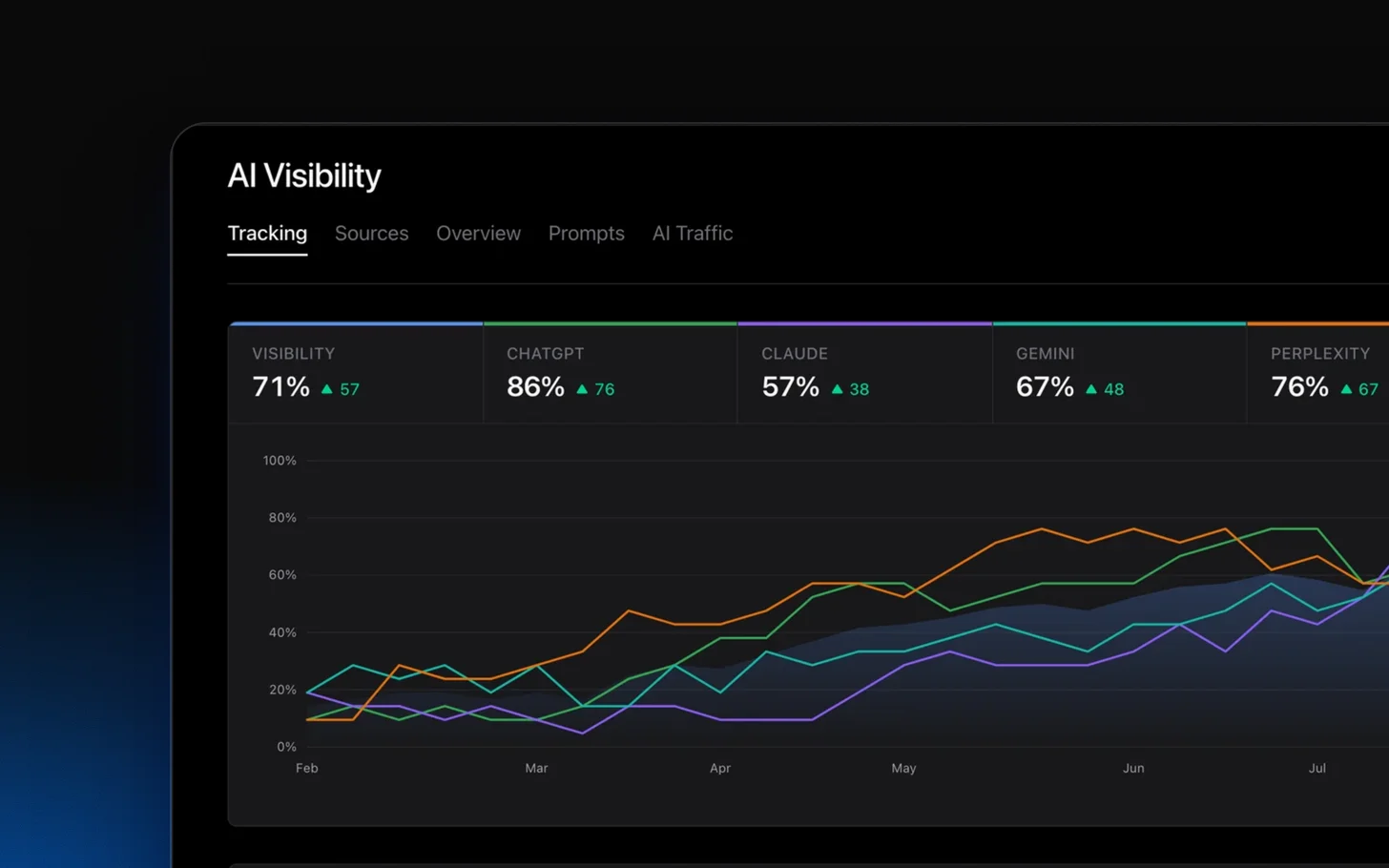
- AI visibility trackers send a fixed set of questions to AI engines on a recurring schedule, then count answers that mention your business. The path a tracker takes into each engine changes what it can see.
- You can reach ChatGPT through the logged-in app, a scraper that copies the app, or OpenAI's API. In our test with one set of 60 local questions, the scraper behind our tracker returned ChatGPT's search queries in 9 of 180 responses, while the logged-in app carried them in the data for all 60 questions.
- We covered six vendors, and four say they collect ChatGPT answers through the web interface.
- There's no shared formula for visibility. Peec AI divides by all answers, while Profound and Local Falcon leave out answers that name no businesses.
- Most tools assign a country to each question. We read three local-focused trackers, and none states how it passes location to ChatGPT.
- The free checkers from Ahrefs and Semrush each use their own set of questions. HubSpot's grader asks models about your brand using what they learned during training.
- Google and Microsoft each report on their own AI answers. We haven't found an OpenAI report that lets a business see its mentions.
What does an AI visibility tool measure?
An AI visibility tool measures how often an engine names or cites your business across a set list of questions. How the tool accesses each engine shapes what it can see. For ChatGPT, a logged-in browser gets everything a customer's browser gets, including data the browser doesn't display. A commercial scraper of the ChatGPT app, such as DataForSEO, returns a structured copy of each answer, and OpenAI's API gives developers a separately configured model.
In our batch of 60 local questions asked in a logged-in ChatGPT account and through DataForSEO, the scraper mostly identified which businesses appeared on ChatGPT's card of businesses but lost much of the surrounding material. The scraper had ChatGPT's own search queries in 9 of 180 responses, and the app had them for all 60 questions. OpenAI's API drifted further from the app, naming the business we track 55 times across 309 matched pairs, compared with 143 for the app read via the scraper. We compare the routes in depth in How to run AI visibility tracking.
Our tests covered one scraper and one API model, so the results aren't a verdict on other vendors. Those limits are why we'd start by asking a vendor how it collects answers. At Complete SEO, our tracker scrapes ChatGPT and Gemini and uses APIs for Perplexity and Claude.
What each tool says it measures
All six vendors report a count of how often you're named, citations, and a comparison with competitors. Four say they collect ChatGPT answers through its web interface. The table reflects each vendor's own pages as we read them on Sept. 25, 2026. "Not documented" means we didn't find that detail on those pages.
| Tool | What it reports | Engines it names | How it says it gets answers | Location |
|---|---|---|---|---|
| Profound | Visibility score, share of voice, average position, citation share, sentiment | ChatGPT, Perplexity, Google AI Mode, Gemini, Microsoft Copilot, DeepSeek, Claude, Google AI Overviews, Exa Search | Captures answers "directly from the consumer browsing experience" and says it doesn't use model APIs. Each prompt runs once a day on each engine | A region, "The country a prompt is scoped to" |
| Semrush AI Visibility Toolkit | AI Visibility Score (0 to 100), mentions, citations, share of voice, sentiment. Prompt tracking adds average position | ChatGPT, Gemini, Perplexity, SearchGPT, Google AI Mode, Google AI Overviews | Its prompt database is "captured from real requests and not via any APIs of LLMs." Prompt tracking queries each prompt daily, desktop only | A location and language for each tracking campaign. How fine a location can be isn't documented |
| Peec AI | Visibility, share of voice, position, sentiment, sources and citations, and flags for ads and maps | ChatGPT, Google AI Overviews, Google AI Mode, Perplexity, Gemini, Microsoft Copilot by default, more as paid add-ons | ChatGPT "via UI simulation," with an OpenAI Search API model as a separate add-on. Daily | The country the prompt "runs from" |
| Otterly AI | Mentions, share of voice, average rank, sentiment, website citations | ChatGPT, Google AI Overviews, Google AI Mode, Perplexity, Gemini, Microsoft Copilot, Claude | Posts prompts "through the website of the AI search (like chatgpt.com etc)," with an API for Claude only. Daily | A country for each prompt |
| Scrunch | Brand presence, share of voice, citations, sentiment, placement in the answer | ChatGPT, Perplexity, Gemini, Claude, Google AI Mode, Google AI Overviews, Microsoft Copilot, Grok, Meta AI | "browser automation and official platform APIs," with the method for each engine not documented. Daily for 14 days, then every 72 hours by default | Country results on engines that support it. Suggests adding cities to prompts |
| Ahrefs Brand Radar | AI share of voice, mentions, citations, estimated impressions | Google AI Overviews, Google AI Mode, ChatGPT, Perplexity, Gemini, Copilot, Grok (new data paused), Claude (custom prompts only) | "the web version of each AI chatbot using the default model," with Claude by API. Its prompt index refreshes monthly, custom prompts up to daily | The source keyword's location for the index. Locations you choose for custom prompts |
The same set of answers can produce different visibility scores. Peec AI counts answers naming you out of all answers, Profound counts them out of answers naming at least one brand, and Local Falcon's Share of AI Voice excludes grid points with no business listed. Semrush's AI Visibility Score is a 0-to-100 index combining topic coverage with consistency of mentions.
With ten answers, four naming you, four naming only competitors, and two naming no business, the every-answer method gives 40% and the named-business-only method gives 50%. Purely informational questions tend to name no business, so adding more of them to the set increases the difference between the two percentages. Our tracker divides by all answers.

Accounts come up on two of the six vendors' pages. Ahrefs says prompts go in "without any stored user data or prior context," while Otterly says it asks "as a neutral, non-personalized user." Our earlier app-vs-scraper comparison ran on a logged-in account. We haven't measured how signed-out sessions differ from logged-in ones.
Free ways to check
A free checker covers less than a tracker. Ahrefs and Semrush report on questions they've chosen, while HubSpot rates how models portray your brand based on what those models learned in training.
- Ahrefs' free AI Visibility Checker takes a brand name and sends search-backed prompts to ChatGPT, Gemini, Perplexity, Copilot, and Google AI Overviews. Ahrefs builds these questions from what people search on Google, and the one-time snapshot's preview shows only the first five results per section.
- Semrush's free AI Search Visibility Checker takes a domain and pulls from what Semrush calls "a database of 26M+ prompts and responses across ChatGPT, Gemini, AI Mode, and AI Overviews." You can use it three times per day without an account.
- HubSpot's AI Search Grader now appears at the old AEO Grader address and says it "sends your brand information to ChatGPT, Perplexity, and Gemini and asks each model how it characterizes your brand based on its training data." It names GPT-5.4 mini as its OpenAI model, and a form is required to see the full report.
None of these tools asks your customers' questions about your line of work in your town unless a vendor's set happens to include them. For a no-cost way to check those questions, use the hand check in our guide. Ask a handful of customer questions, put each in a fresh chat, spread the checks over several days, and tally the results manually.
Trackers built for local businesses
Local Falcon, BrightLocal, and Local Dominator are local SEO tools that now track AI answers, and each ties its questions to a location. The pages we read don't explain how that location reaches ChatGPT, and they don't say whether a count covers only businesses visible on screen or the whole pool behind Expand.
| Tool | Engines it names | What it reports | How it says it places a question | How often | Collection route |
|---|---|---|---|---|---|
| Local Falcon | ChatGPT, Google AI Overviews, Google AI Mode, Gemini, Grok | Share of AI Voice, a Buyer Persuasion Score, average rank | Runs "the same prompt through AI multiple times across a specified geographic area," one answer per grid point, 9 to 441 points | On demand or on a campaign schedule | Not documented |
| BrightLocal | ChatGPT, Google AI Overview, Google AI Mode | Visibility score, mention rate, share of voice, average position | "every query we run is anchored to a specific location" | When you re-run it, with scheduled updates planned | Not documented |
| Local Dominator | ChatGPT, Gemini, Google AI Mode, Perplexity, Claude, Grok | Visibility score, mentions, average position | A location entered at setup, with supported countries listed for each engine | On demand, weekly or monthly | Not documented |
What counts as appearing on ChatGPT's card carries more weight for a local business than for a national brand. The scraper we use returns the card and the pool behind Expand as one merged list, so a tool reading that list counts roughly ten businesses. A customer sees only the top few. Across our 57 cards, that was just under four businesses on average.
How a question lands in your town also carries more weight for a local business than for a national brand. OpenAI says ChatGPT "may use an approximate location based on your IP address to provide relevant local results," and for people seeing local results in the wrong area, its help page says, "Include your city, neighborhood, or postal code in your question." Scrunch's help recommends putting cities into tracked prompts, and Local Falcon's sample questions include the neighborhood or city. Our tracker writes the town into every phrasing because its scraper sets the whole United States as the origin for all questions.
A grid scan collects answers at one moment. In our repeat study, runs within a sitting behaved like draws around that sitting's rate, and the rate shifts between sittings. Read each scan as a single sitting and compare scans made on separate days.
What Google, Microsoft and OpenAI report
Google and Microsoft each report on their own AI answers, and neither names ChatGPT. Google's free Search Console has a generative AI performance report that counts appearances of links to your site in AI Overviews and AI Mode. Its rollout to every site was complete as of Aug. 31, 2026.
Microsoft added its AI Performance report to Bing Webmaster Tools in February 2026 as a public preview. It shows, in Microsoft's words, "how often your content is cited in generative answers" across Copilot, Bing's AI summaries and partner integrations Microsoft doesn't name.
Both reports measure your pages as cited sources, so a mention of your business without a link to your site won't appear in either one. We haven't found an OpenAI report that lets a business see its mentions or citations. The guide's traffic section covers what ChatGPT's links carry.
How do you compare two tools?
Ask every tool the same method questions and, if you can, run two side by side on an identical question set over the same days. We've adapted the questions from our tracking guide for choosing a tool. Use these questions:
- For each engine, does the figure come from an app, scraper or API, and is the session signed in or out?
- How many separate days and how many answers underlie each figure?
- Is visibility divided by every answer or only by answers that name a business?
- What rule determines whether a business was named, and what's that rule's miss rate?
- Do card counts include only the handful shown or the full pool behind Expand?
- How is a question placed in your town?
- Are ChatGPT's ads captured?
- Is a band shown, and is a rank or average position reported?
Logged-in and logged-out users may be served different models, and OpenAI's release notes have announced model updates "for signed-out users." Name matching adds error. On a 150-answer reference set drawn from our census, DataForSEO's own business-name field caught 43.1% of the businesses, while our extractor caught 92.6%.
Peec AI and Otterly both say they track ChatGPT's ads. On 16 fresh local questions, the logged-in ChatGPT app showed an ad on 10, while the scraper we tested returned none of them. In our repeat study, asking one local question again returned an identical business set 3.6% of the time. We think that leaves little that's stable for a rank or average position to describe.
Vendors publish comparison pages, such as Profound's page on Semrush, with an outside view of their rivals. Check claims about a tool against that tool's own docs. The same questions apply to our tracker. Clients of our AI search work get its numbers with a band, and any move inside the band is shown in gray.
What drives the cost
Your cost follows the number of answers a tool collects. Multiply engines by questions by runs, then multiply by locations or grid points when a tool offers them. Ahrefs defines one check as "1 prompt execution × 1 LLM × 1 location" and Peec AI's agency plans use "1 prompt × 1 model × 1 day = 1 credit" as their billing unit. Local Dominator multiplies prompts by engines, and Local Falcon charges one credit per grid point.
Profound's plan tiers vary by prompt count, run frequency, engine count, languages, and regions. Most of these vendors have pricing pages, and prices can change, so check them on the day you buy. Collecting fewer answers costs less and leaves a wider band around the number.